
Why Data Privacy Matters When Choosing a TMS and Cost Solutions Vendor in Freight
Your Rate Data Is the Product You're Paying For
Every broker evaluating a Transportation Management System (TMS) or a cost solutions vendor asks about uptime, integrations, and implementation timelines. Far fewer ask the question that decides whether the platform builds their edge or erodes it: where does my pricing data go after I enter it?
Freight broker data privacy is not a compliance checkbox. It is a margin question. Feed your rates into a "neutral" pricing tool long enough, and somewhere inside that neutral number is your margin, priced into a figure every broker querying the same tool can see, including the one bidding against you on the next load.
This is what to look for in a TMS and cost solutions contract, what the standard terms of service actually let a vendor do with your freight data, and how to tell an architectural commitment from a marketing promise.
What "Your Freight Data" Actually Covers
When a vendor contract says "customer data," it means more than the loads in your system. It means the operating record your brokerage generates every day:
Rate history: what you quoted, what you paid, and what you won
Lane performance: including seasonality, and volume patterns
Carrier history: who covers what, at what price, with what service
Pricing decisions: the target buy rates and the margin thresholds behind them
Quote timing: including accept and reject behavior, and RFP outcomes
Any one of those records is operational exhaust. Stacked up, they're a detailed portrait of exactly how your brokerage prices freight and where your margin sits. Writer Jennifer Morris makes the point well in Ship Happens: that portrait is "worth real money to the right buyer even when no single piece of the data can tell you much on its own."
That is the asset your TMS and cost solutions vendor is holding.
Why Pooled and Blended Data Costs You Margin
A "neutral" data layer sounds safe. Neutral means pooled, or the same average feeding every broker who subscribes, including the ones competing with you for the same freight.
The mechanics are simple. You price a difficult lane well. That win enters the pool. The benchmark moves. Your competitor queries the same tool and prices closer to your number on the next bid. You paid for the insight; the market got it for the price of a subscription.
Morris puts the consequence bluntly: "'anonymized' rarely means untraceable and 'aggregated' just means your edge is now everyone's baseline."
Pooled-data tools rarely disclose whose numbers make up the average, which means you cannot audit how much of your own book is sitting inside the figure your competitor is quoting from. Anonymization doesn't fix that. A blended benchmark doesn't need your name attached to move against you, it only needs your numbers.
What You Probably Already Signed
Most brokers never chose any of this. They clicked through it. Broad usage and sharing rights are the industry default, tucked into terms of service nobody reads line by line at onboarding.
In Who's Data Is It Anyway?, Morris lays out where those terms usually hide the problem. Three clauses deserve a slow read before you sign a TMS or cost solutions agreement:
Aggregation and anonymization rights. Any clause letting a vendor aggregate, blend, or anonymize your data and pass it onward is a clause that converts your pricing edge into someone else's baseline.
Undefined third-party sharing. Broad sharing language with no actual list of third parties is a blank check. Ask for the list in writing.
Silence on export. "Ownership isn't worth much if you can't walk out the door with your data when you switch providers," Morris writes, and rebuilding an operating history from zero is a real cost that never appears as a line item.
Her advice on the fix is the part worth acting on: get the export and usage terms written into the contract before you sign, not after you are already trying to leave. A friendly rep and a handshake are not a data policy. And go looking for the opt-out — if the agreement mentions feeding analytics, benchmarks, or "product improvement," find out whether you're allowed to say no and what saying no costs you in service.
Architecture Beats Policy
A policy page can be revised. A settings toggle can be flipped, by you or by a future product decision. Architecture is harder to walk back, which is why it's the standard worth holding vendors to.
Transfix ran a brokerage for over a decade before licensing the platform to other brokers, and never wanted its own numbers training somebody else's model. That's why data isolation on Transfix is an architecture principle rather than a policy promise:
Per-broker data isolation. Your freight and carrier history stays on your own account, never merged with another broker's.
No blended benchmarks. Custom Cost Models train only on your data, not a "neutral" market average or index.
No cross-training. Your pricing decisions never become training data for anyone else's model, and nothing another broker enters trains yours.
Proprietary by default. The same boundary applies whether you run a proprietary TMS, standalone, or a phased integration.
No outside visibility. Your team sees your data. No other brokerage ever does.
When you evaluate a cost solutions vendor, the useful question isn't "do you protect my data?" It's "what in your system makes it impossible for my data to reach another broker's model?" A vendor with an architectural answer will give you one. A vendor with a policy answer will give you a paragraph.
Isolated Data Doesn't Mean Weaker Pricing
The objection to data isolation is always the same: surely a model trained on the whole market beats one trained on my book alone. The results say otherwise, because a model tuned to your cost structure beats an average tuned to nobody's.
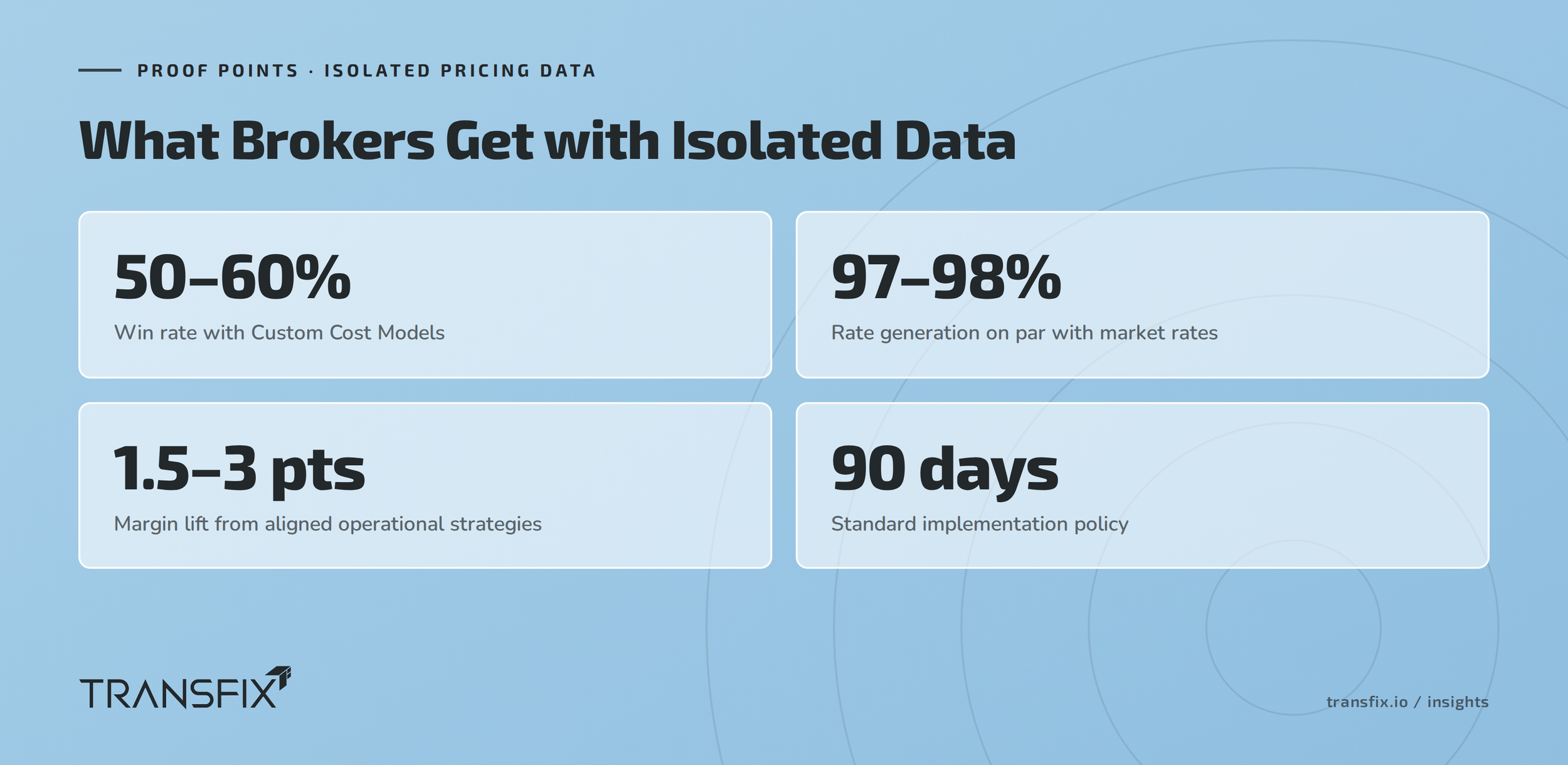
How isolated data can impact your business
NFI, one of the largest logistics companies in North America, started with Transfix in a single brokerage unit and expanded across its entire brokerage division after seeing the pricing accuracy and margin lift on live freight. That pilot-to-expansion path lets you prove data isolation holds up on your own desk before a full rollout.
This is the commitment in Transfix's data privacy promise, verbatim:
We believe your data should stay yours and yours alone, without the risks of sharing or blending insights across companies, like other costing solutions on the market. We don't rely on anonymized estimates and we don't aggregate our clients' data; our models are fully tailored, ensuring that your insights and competitive edge won't inadvertently support the broader market or show up in other clients' cost predictions.
Seven Questions to Ask Before You Sign
Bring these to the next TMS or cost solutions demo, and ask for the answers in writing:
Is my freight and pricing data ever aggregated, blended, or anonymized into a shared dataset?
Does my data train models that other customers use? Does theirs train mine?
Is that separation enforced in the architecture, or is it a setting and a policy?
Which third parties receive my data? Name them in the contract.
What is the export process if I leave, and in what format do I get my history back?
Is there an opt-out for analytics and "product improvement" use, and what does opting out cost me in service?
Do the same terms apply across proprietary TMS, standalone, and phased integration environments?
Morris's closing point applies to all seven: every agreement is negotiable, and you have the upper hand of being the buyer. Have counsel read the agreement, and if you are willing to let a vendor use your data, get something concrete for it.
Your Edge Should Stay Yours
Freight broker data privacy comes down to one test: after the contract is signed, does your pricing history still work only for you? If a vendor cannot answer that structurally, the answer is probably no.
Transfix trains Custom Cost Models on your freight and carrier history alone, never pools it, and never lets another brokerage see it. That is the architecture, not the pitch.
See how data isolation works on Transfix, or get a personalized demo and test it against your own book.
