
TMS Software for Brokers Built for Margin Control
Article brief:
TMS software for brokers should be able to help protect margin through the entire load lifecycle – from the initial quote through to coverage, tracking, invoicing, and reporting.
Pricing is more effective when rate intelligence, carrier data, and target buy rates are in the same workflow that the brokerage uses to move freight.
A modern freight broker TMS can eliminate double data entry, give teams instant visibility, and make it easier to spot lane profitability before a load closes.
The right transportation management system should let a brokerage grow load volume without adding headcount.
Transportation management systems often enter the loop too late. Too many freight brokers treat the application like a glorified tracking tool, but think about it. Bringing in the TMS only after the customer accepts the quote ignores margin protection and control, which are fundamental to brokerage operations.
A good TMS software for brokers should have influence on a load’s earnings from the first pricing decision through final settlement because execution matters just as much as pricing, carrier selection, and coverage. When those decisions are scattered across tools, email threads, and spreadsheets, it is harder to see where margin started to slip. Any margin-focused freight broker ought to bring pricing and execution into the same operating workflow.
Why TMS software for brokers has to control more than the load
A brokerage can execute a load perfectly but still lose money on it.
For instance, say your brokerage has sold a $2,600 quote to a shipper. But carrier sales covers the load at $2,400 because there was no clear target buy rate, so the rep had no way of knowing whether $2,400 is an acceptable rate at the company.
Now instead of maybe $450 (with a target buy rate of $2,150), the brokerage is left with only $200 on that transaction, and that is before other issues like, say, detention. By the time the shipment closes, staff time and avoidable operational work have eaten a significant chunk of the already thin margin. But a margin-focused TMS could have avoided all of that.
The load lifecycle offers brokers many chances to protect or lose margin, starting with the sell rate, then the target buy rate and carrier selection, and ending with shipment tracking, exception management, delivery, invoicing, and carrier payables. That is why load management isn't just a dispatch issue.
Freight broker software varies by vendor. Some systems emphasize load creation and execution. Others include pricing or analytics, accounting tools, real-time tracking, and carrier management. For a brokerage that cares about profitability, the question is how well those pieces communicate with each other.
Your team shouldn't have to spend time reconstructing the economics of a covered load after delivery. With TMS solutions like Transfix, the data needed to judge that system is already in one system, and all the pieces communicate with each other.
Freight brokers need pricing inside the operational workflow
Pricing influences pretty much every decision, which is why it is so important to embed pricing in the workflow rather than in a separate tool someone has to remember to check. This way freight brokers have more control.
Historical freight data is also important because while market rates can tell you what is happening across a wider set of lanes, a brokerage’s own operational data gives you more insight into what customers are willing to pay, what carriers typically accept for any given lane, which lanes deliver healthy margin, and where previous quotes won or lost.
Some freight broker software ties TMS data to market benchmarks. That could be useful, but a market average doesn’t know that a certain brokerage has exceptionally strong carrier relationships in Atlanta, or that it continually struggles covering a certain reefer lane out of South Texas.
The more context the system can absorb, the more accurate the pricing will be.
Transfix's AI-powered pricing uses custom cost models trained around each customer’s freight, rather than blending broker data into one shared model, which is why our pricing models generate rates that are 97 to 98% in line with market-clearing rates. Customers have also seen a 20 to 30% improvement in rate accuracy, with win rates reaching 50 to 60%.
That pricing intelligence is also available within quoting, RFP, coverage, execution, and invoicing workflows. This way, the number you use to win the load is tied to the decision you will use to move it.
Freight broker software should connect historical data to live pricing
If the person making the quote can find all necessary historical data in one application, it becomes much more useful.
Take a pricing analyst working from a spreadsheet, for example. She may eventually come up with a good number after combing through market-rate subscriptions and internal lane history, but the repeated manual work makes consistency difficult.
A modern TMS can bring these signals together at the point of pricing. For example, Transfix’s pricing product today mixes broker-specific history with market inputs, while keeping customer data separate from other brokers’ models. That makes a lot of difference in volatile lanes. A benchmark shows you where the market has been trading, and your own carrier data will tell you what your brokerage can actually purchase.
A freight broker TMS should set the target before carrier selection
A disciplined target gives the desk a reference point before negotiations begin.
Transfix pulls the brokerage’s own freight and carrier history to generate target buy rates, and pushes the number into the coverage workflow. Its documented approach also shows the buy rate and sell rate together so the expected margin can be observed while the load is covered.
Still, carrier selection requires judgment because the cheapest carrier isn’t always the best. Carrier performance, service history, acceptance patterns, and customer requirements can influence that decision. Whatever the case, though, sound judgment improves when it starts with better data.
The load board is only one part of sourcing capacity
Load boards can help brokers find capacity, but carrier management can’t just be about finding a truck that’s available.
Helpful carrier data can tell you which carriers perform well on a lane, which have good tracking, how often they take freight, and where service problems tend to pop up.
That context can also strengthen carrier relationships. Simpler carrier onboarding, clearer communication, and fewer duplicate requests for the same information eliminate friction on both sides. You can add another layer with carrier scorecards. Instead of relying on memory to know the "carrier usually does a good job,” the ops team can look at the actual carrier performance and make a more informed call.
Load management should protect margin after coverage
Once a carrier has accepted the rate confirmation, the load is no longer financially secure. Even a profitable move can be eaten into by poor execution.
Load management should include creation, booking, dispatching, and tracking of shipments while keeping exceptions in view of the people who can act on them. A TMS that automates shipment tracking can also reduce the time brokers spend making check calls or digging through email threads for status updates.
Real-time visibility is everything when things go wrong. If a truck is late to pickup, an appointment changes, or tracking drops, the brokerage has more time to respond when the problem appears early in the system. It is not the same conversation if you have to wait for the shipper to say, “Where is my freight?” before taking any action.
And operational problems can be costly. Missing an appointment could result in detention or poor tracking, which can require several phone calls for something you can simply track on a screen. Even a missing document can delay billing. None of these costs will be factored into the original buy rate, but the brokerage still pays them.
Real-time visibility protects customer relationships
Customers usually care less about the tracking feature and more about getting reliable information when they need it.
A TMS with real-time visibility can keep shippers and carriers updated without requiring the ops team to repeat the same update multiple times. Shippers can also track shipments themselves through customer portals instead of calling the brokerage to check on every location.
In practical terms, that changes customer service. Think about it, more frequent shipment updates mean fewer missed details and fewer surprises. The shipper gets a faster response, and the broker has less time to chase it down. Over time, even the customer relationships is strengthened because good service starts to feel predictable.
Reducing manual work changes how freight brokerage teams scale
Increasing load volume should not automatically lead to adding headcount.
But that’s what happens in many freight brokerage operations where every new load also creates more data entry, check calls, billing work, and carrier follow-up. Think about how many touches one shipment involves.
Someone loads it, and someone else passes along the rate confirmation. Then they handle the tracking information the customer needs when they ask for an update. Delivery documents arrive, and accounting generates the invoice and processes carrier payables.
Now, imagine having to generate that same information in multiple places. You can see how the load volume inevitably becomes a staffing issue.
By eliminating those duplicate touches, TMS software increases productivity. Automating billing can remove rekeying and get a completed shipment one step closer to invoicing. Automated dispatch and communications can send updates by email, text message, or driver application. Standard workflows also make it easier for another employee to pick up a load without reading through a 30-message email thread.
Using Transfix, our customers save roughly five minutes on each spot-load quote, while contract lanes can be priced in 3 to 7 seconds. These savings can make a significant difference at higher load volumes.
Why integrations matter in a broker TMS
A TMS won’t eliminate manual entry if the rest of the brokerage still runs on disconnected systems, which is why integrations matter.
A broker already may have a load board, tracking provider, accounting tools, carrier onboarding system, and EDI integrations with shippers. But if all of these are not in a single platform or unable to communicate with each other, so employees need to copy data between those tools, the brokerage has only just transferred the spreadsheet problem across multiple browser tabs.
Good integrations cut down on handoffs. A load created in the TMS should not require someone to re-key the same information into an accounting system. The tracking data needs to get back to the people managing the shipment, and carrier information should be available when someone needs to source capacity again. Integration also affects adoption rates.
Transfix’s approach to integration means the platform can plug into existing TMS, load board, and carrier tools or serve as the TMS itself where appropriate.
Broker TMS platforms should make margin visible before it disappears
Broker TMS platforms should convert operational data into decisions while there is still time to change the outcome. Reporting can be done with a dashboard showing final margin after delivery. A system that shows the sell rate, target buy rate, expected margin, and carrier cost while the rep is covering the load can make a difference in the outcome. That is so important.
Modern TMS platforms can do more than simply store operational data. Depending on the system, they may also analyze lane history, monitor carrier performance, flag exceptions, support pricing decisions, and provide real-time tracking.
The same goes for the distinction between freight broker software and a TMS. The categories are increasingly overlapping. A transportation management system with a brokerage focus might already do the quoting, load management, carrier management, tracking, and financial workflows that another vendor sells as freight broker software.
Feature counts alone won't answer the question. A better test is whether the software gives the whole team enough information to make a better decision on the next load.
Freight broker software cost should include the work around the software
Freight broker software costs more than the monthly subscription. Now, of course, subscription cost still matters. But ask whether a vendor provides transparent pricing, charges per user, offers unlimited users, lets customers cancel anytime, or requires long-term contracts. But software cost also includes everything the brokerage must buy or do around the TMS.
However, the monthly bill doesn’t include the full operational cost of a low-cost system that, for example, requires a separate pricing tool, a tracking provider, and a number of manual back-office processes. The same is true if the brokerage has to add people every time load volume goes up.
Implementation deserves equal scrutiny. A system that looks cheap can be expensive if it takes months of internal resources to migrate, or requires the ops team to run two processes in parallel.
Transfix’s current commercial approach includes a 90-day implementation policy for teams considering a change. Our TMS migration page addresses the more general question of migration. But the real number is the cost of running the brokerage after the software is live.
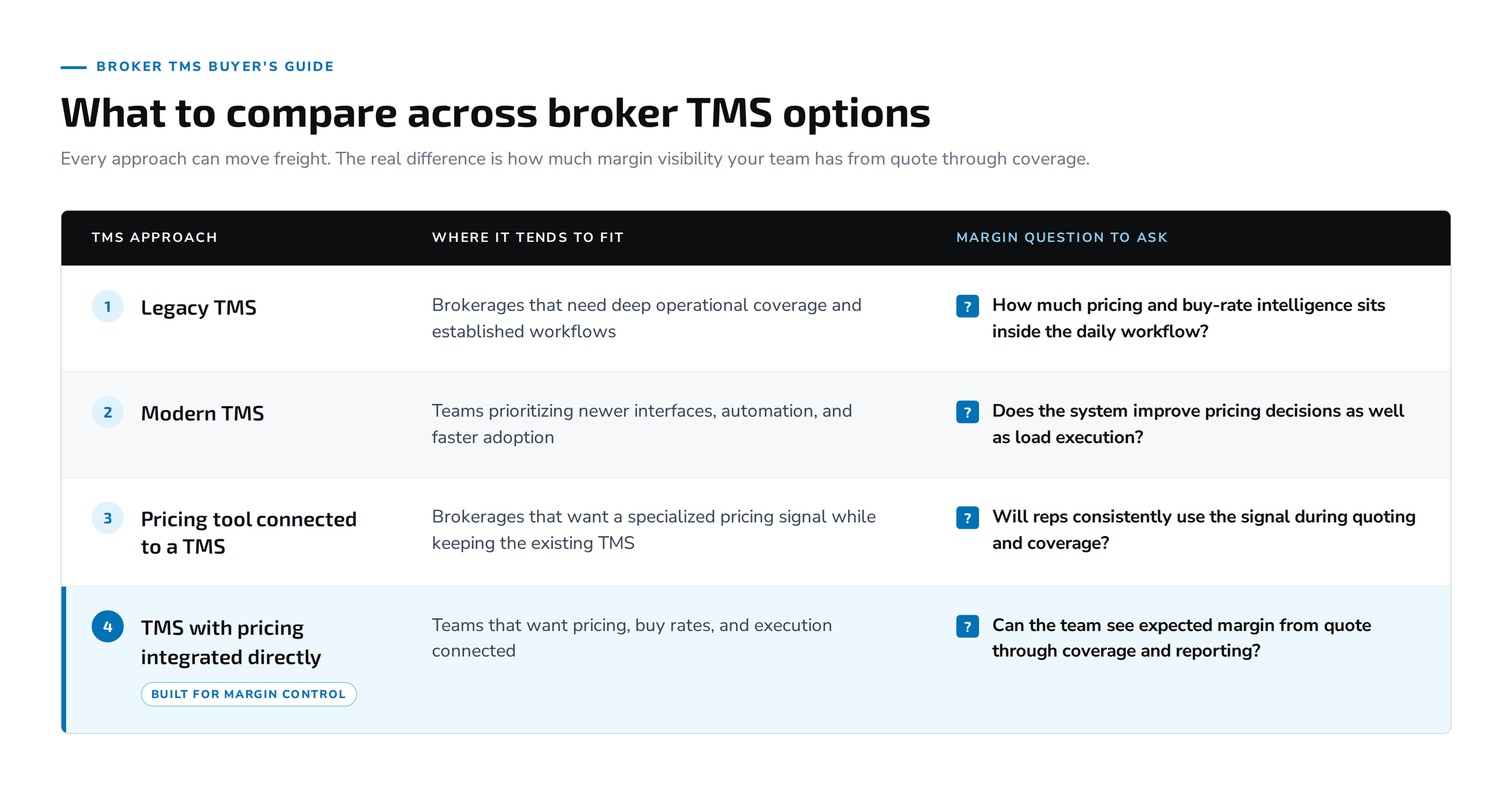
What to compare across broker TMS options
Where Transfix fits in a margin-focused brokerage
Before our TMS solution, we ran our own brokerage for over a decade and built Transfix from a TMS informed by the decisions that impact margin every day. This includes pricing, RFPs, target buy rates, carrier coverage, execution, and invoicing, all in one operating workflow.
We train our Custom Cost Models on each customer’s freight, but we do not aggregate or combine broker data between customers, so they cannot see each other’s data to ensure data privacy. This ties pricing intelligence to the freight a brokerage actually moves rather than feeding a shared pool that competitors could also access.
That approach has brought tangible benefits to customers. Our models have produced rates that are 97 to 98% aligned with market-clearing rates. Customers have also seen a 20 to 30% improvement in rate accuracy. Win rates are 50 to 60% with margin gains of 1.5 to 3 points.
The bigger point is what follows the quote. Once the load is won, pricing shouldn’t get lost in another tool. The same data should help the team set a target buy rate, cover the load, track execution, and see if the expected margin made it through the trip. That's where our solution works best. Our platform works best for data-rich, continental U.S. freight brokerages with significant dry van and reefer volume, especially teams with high spot and RFP activity. Schedule a demo today to get started.
Frequently Asked Questions
Q1. What is the difference between freight broker software and a transportation management system?
The terms overlap more than they once did. A transportation management system traditionally manages load execution, including load creation, dispatch, tracking, carrier management, and financial workflows. Freight broker software may also include pricing, customer management, carrier tools, and analytics. Many modern broker TMS platforms now combine both sets of functions, so buyers should compare actual workflows rather than product labels.
Q2. How much does freight broker TMS software cost?
Pricing for freight broker TMS software varies based on load volume, users, integrations, implementation work, and included functions. When comparing freight broker software cost, a brokerage should also factor in separate pricing tools, tracking systems, manual labor, and added headcount. A lower subscription doesn't necessarily mean lower operating costs.
Q3. How does Transfix help freight brokers control margin?
Transfix connects Custom Cost Models, target buy rates, and operational workflows inside its freight broker TMS. Pricing models train on the customer's freight, target buy rates appear during coverage, and buy and sell rates remain visible as the load moves through the system. Transfix reports customer margin improvements of 1.5 to 3 points alongside 50 to 60% win rates.
Q4. Can Transfix replace separate pricing and load management tools?
Transfix is designed to bring pricing, RFP workflows, carrier coverage, execution, invoicing, and reporting into one platform, although the right setup depends on the brokerage's existing systems and integration needs. It can also connect to existing tools when a full replacement doesn't make sense immediately. The best starting point is the Transfix freight broker TMS platform and its integration options.
