
Broker TMS vs Generic TMS: How to Differentiate Between Them
Article brief:
A broker TMS supports quoting, carrier sourcing, coverage, tracking, invoicing, and carrier payables.
A generic transportation management system usually meets the broader needs of shippers, fleets, or enterprise transportation.
Both can provide load management and visibility, though the workflow around those features can create very different day-to-day work.
The right TMS for a brokerage should tie together load, carrier, and financial data across the entire load lifecycle.
Comparing broker TMS vs. generic TMS boils down to the operating model behind the software. While both systems may handle loads, carriers, and shipment tracking, a broker TMS is designed to work with and streamline the day-to-day operations of freight brokers, while a generic transportation management system might be built for shippers, fleets, or larger enterprise transportation teams.
That difference is evident in the work of building a load and paying a carrier. A brokerage has to price freight, source capacity, check carriers, protect margin, update the customer, and settle both sides of the load. If the TMS was built around a different operating model, the team may end up filling the gaps with spreadsheets, phone calls, and manual data entry.
Broker TMS vs. generic TMS: the main difference
A broker TMS is usually built for high-volume brokerage transactions. In an internal supply chain, a generic TMS typically starts with transportation planning, routing, and execution.
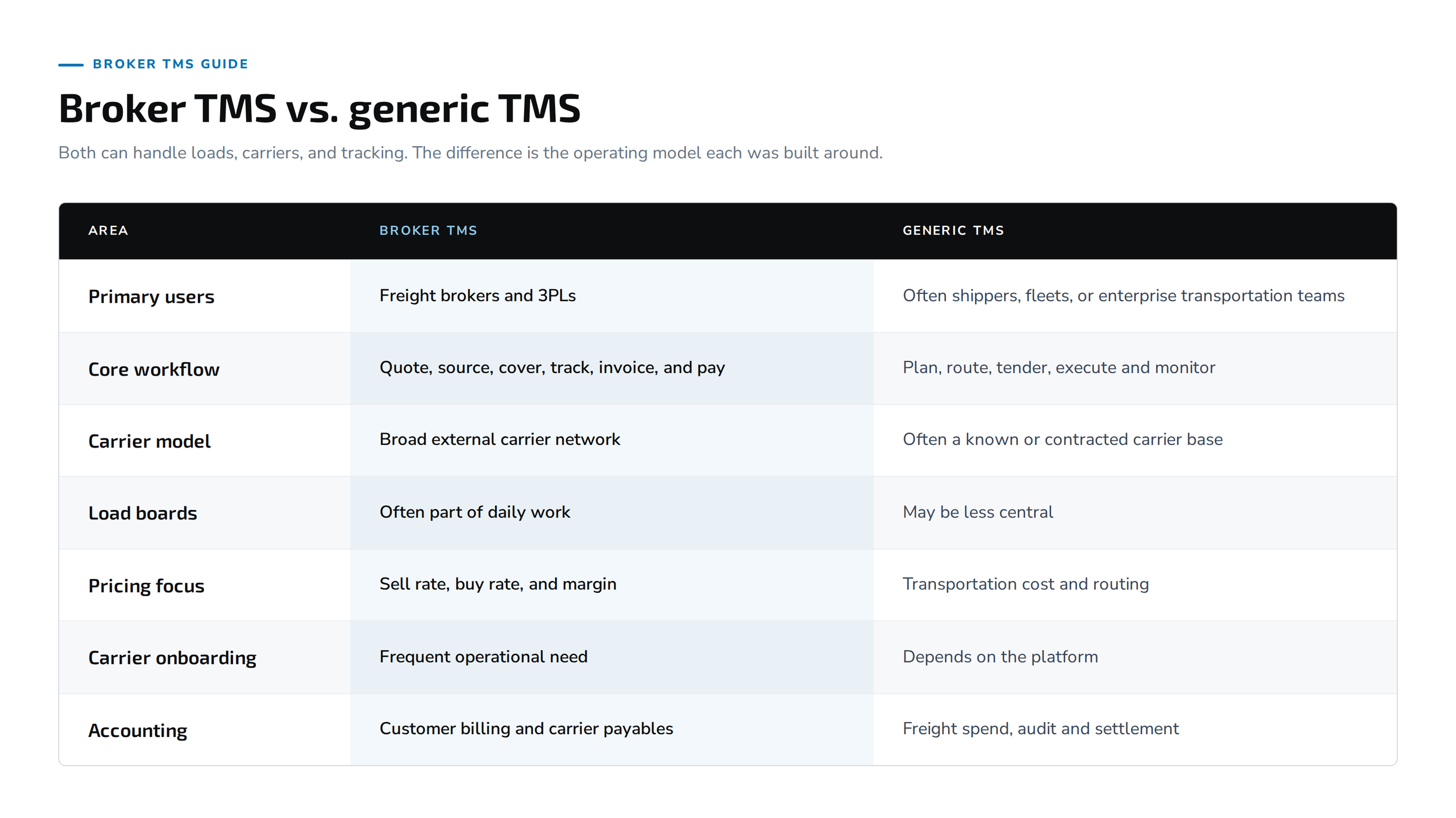
There are a lot of overlaps. A modern transportation management system can support many business models, and generic TMS platforms can be configured for brokerage work. For a brokerage, though, the real test is how much extra work the brokerage has to build around the system.
Generic TMS starts with transportation planning
A generic transportation management system usually starts with a company that makes the freight decision. The shipper knows what needs to move, where it needs to go, and what transportation options are available. Here, the TMS helps plan the movement. It can support route selection, tendering, contract compliance, freight audit, warehouse connections, and visibility across multiple modes. But ultimately, transportation is part of a larger internal supply chain, so ERP connections may also matter.
The model works well for many companies. But not so much for an active broker because they have to buy capacity on the market while waiting for a quote or for a truck to pick up for a customer. A planning-oriented system can support that work, but it may need additional configuration to fit a brokerage desk naturally.
Broker TMS starts with buying and selling capacity
A freight broker TMS begins further up the commercial transaction just after the load is won. The brokerage needs to have a sell rate for the shipper and a buy rate for the carrier. Pricing, carrier sourcing, and coverage are interconnected from the very beginning because these two values produce the target gross margin, and the workflow runs from quoting to invoicing.
Take a dry van load from Chicago to Atlanta. A broker can review lane history, current market data, and past carrier performance before quoting the customer. Once the load is won, carrier sales has to lock in capacity quickly enough to maintain the margin assumed in that quote, with broker-specific workflows for fast quoting, tracking, and carrier communication. That work is a different kind of pressure on the software.
A broker-centric TMS needs to keep the quote, load record, carrier options, buy rate, and coverage decision centralized across the load lifecycle in one system. If those steps live in different tools, the team starts copying data from screen to screen, which derails the entire process.
The carrier model changes everything
Carrier network is the biggest operating difference. A shipper may have a specific set of contracted carriers, but the average freight broker has access to a much larger pool and may need to work with a new carrier on short notice. That brings carrier records and carrier history into the live coverage process.”
As the rep figures out who should move the freight, the system may need to surface insurance status, authority, prior loads, carrier performance, lane history, and other data. Besides that decision, there is also concern about fraud, such as double brokering and identity theft.
That data is most useful at the point of carrier selection, which is why carrier management in a broker TMS matters. If the rep has to leave the load, search a different system, then manually reenter the result, the workflow slows down right when speed matters.
Brokerage speed exposes workflow gaps
An extra manual step may seem harmless on one load. But multiply that by hundreds or thousands of loads, and the team starts spending hours on manual data entry, status checks, and repetitive work. That is why load board integrations, electronic data interchange, tracking connections, and accounting tools matter in a broker setting.
The value is in how the load data behaves after the connection. The EDI tender auto-creates the load record, so no one has to create it manually. When tracking data is sent to the existing shipment record, real-time visibility gives customers better communication while reducing manual status updates for brokers instead of the rep calling the driver. The back office also doesn't have to manually re-enter data after delivery when the carrier and financial data are on the same load, because a broker TMS automates invoicing, reduces billing delays, and improves accuracy.
A high load volume will expose disconnected systems faster than a feature checklist ever will, and the right automation can save brokers up to 30% in operational time.
Generic systems may need more configuration for broker work
A generic TMS can support brokerage operations, but the level of configurability does matter. Some systems are built for complex transportation networks and can support brokerage workflows, but they typically require extensive customization to support broker workflows. That might include custom screens, new integrations, separate carrier tools, or changes to the way teams build and cover loads.
For a large brokerage with its own technical staff, that exchange might be okay. That configuration burden can be a real cost for a team that wants the software to align quickly with its current operating model and avoid enterprise level complexity. Broker TMS platforms built specifically for brokerage operations, especially for small freight brokerages, have an advantage. Typical work like load building, carrier sourcing, carrier onboarding, shipment tracking, and carrier payables can already be done the way brokerages do it.
A good way to compare it is how much custom work it takes to make the system fit the actual workflows of the business, because integrations matter when connected tools need to support faster, cleaner execution.
Margin data has to stay attached to the load
A broker TMS needs to see the margin while the load is still being worked. Let’s say a customer accepts a quote of $2,400 and the expected carrier buy is $2,050; the broker is starting with $350 in expected gross margin. If it comes back at $2,200, that margin has shifted before the truck rolls, and it should be tied to the load lifecycle.
A generic TMS can track transportation costs, but a brokerage needs to see the commercial relationship between shipper rates and carrier costs because it affects pricing, carrier selection, cash flow, and post-load analysis. The same applies to accessorials, invoice adjustments, and carrier payments. If the financial data lives elsewhere, the brokerage may know what happened operationally, without seeing what the load actually earned.
Execution and margin for brokers are operational and should live in the same record as the operational data behind the load.
How to tell whether your current TMS was built for your business
A good test is to track a real load through your existing system, because choosing the right TMS software depends in part on whether your business acts as an intermediary or manages its own assets. Begin with the customer quote. Then see what happens when the team creates the load, checks current market data, sources carriers, reviews carrier history, confirms coverage, tracks the shipment, collects documents, and sends the load to accounting, and whether a broker TMS centralizes the load lifecycle in one system.
Pay attention to every hand-off. How many times does somebody copy a load number into another tool? Where does the rep leave the TMS to verify a carrier? Does the client automatically receive status updates? Can accounting see the same rate and document data operations used? What if load volume doubles?
Those answers are more important than the number of features on a sales page. A good broker TMS should help make real workflows easier to run and enhance visibility across all freight operations as volume grows. If growth means more spreadsheets, more phone tag, more manual work, the software may be working against the operating model.
Where Transfix fits that operating model
With Transfix, quoting, RFPs, coverage, execution, invoicing, load boards, and accounting workflows are connected in one unified platform around the load. Pricing is part of that operating flow, too. Our Custom Cost Models are trained on each customer’s own freight, and client data is not aggregated or combined across brokerages. This means that brokers cannot view each other's data. The time savings show what that means in practice. Our customers save about five minutes per spot load quote, and contract lanes are priced in 3 to 7 seconds. That efficiency can help brokerages increase shipment volume without adding staff. Our support team also helps during implementation and ongoing workflow optimization. That’s the operating model we believe matters most for a brokerage evaluating TMS platforms. Schedule a demo today to get started.
Frequently Asked Questions
Q1. Can a generic TMS work for a freight brokerage?
Yes. Some generic TMS platforms can support brokerage operations well, especially when the business has the technical resources to configure them. The tradeoff is the custom work, added software, and process changes needed to make the system match daily brokerage workflows.
Q2. What should freight brokers look for in a broker-focused TMS?
Freight brokers should look at how the system handles pricing, carrier sourcing, carrier data, load management, tracking, documents, customer billing, and carrier payables. A broker-focused TMS is essential for speed, compliance, and margin management in brokerage operations. The strongest test is whether the freight broker software being evaluated keeps those functions on the same load record without repeated manual entry, including dual-party invoicing for seamless customer billing and carrier payment processes.
Q3. How does Transfix handle pricing data inside the TMS?
Transfix uses Custom Cost Models trained on each customer's own freight. Client data stays isolated, so one broker's data isn't blended into another broker's model. Pricing then sits inside workflows such as quoting, RFPs, and coverage.
Q4. Can Transfix help a brokerage handle more load volume without more manual work?
That is one of the problems the platform is built to address. Approved customer results include roughly five minutes saved per spot load quote and 3 to 7 seconds of contract-lane pricing, which helps reduce manual entry and automate repetitive tasks as volume rises, so the team spends less time on admin. It also supports faster load creation and smoother operational execution, so once pricing is confirmed, a covered load can move forward without extra back-and-forth.
