
Brokerage TMS vs. forwarder TMS: What is the difference?
Article brief:
A brokerage transportation management system (TMS) is focused on fast quotes, carrier sourcing, load coverage, and margin.
A forwarder TMS focuses on multi-leg international shipments, documents, and job profitability.
Both work on freight, but organize data around different work units.
The right transportation management system will fit the freight business you run.
To compare freight brokerage TMS vs forwarder TMS, start with the core difference: a brokerage TMS is built for fast quotes, carrier sourcing, load coverage, and margin by load, while a forwarder TMS is built around shipment jobs that may cross borders, span multiple legs or modes, require documents, and measure profitability at the job level.
For freight brokers, freight forwarders, and 3PLs evaluating a transportation management system, that difference matters because both systems move freight but organize work around different units. A brokerage TMS is typically centered on the load, carrier capacity, and the spread between shipper rate and carrier buy. A forwarder TMS is more likely to focus on a shipment job that involves several service providers, cross-border steps, and operational documentation.
That changes the workflows the software supports, from quoting, tracking, carrier management, and EDI to accounting, reporting, financial models, and core feature requirements. Choosing the right fit improves efficiency, accuracy, profitability, and scalability; choosing the wrong one forces your team to work around the system instead of through it.
Brokerage TMS vs forwarder TMS: the unit of work is different
The primary difference is the record each system centers on. In a freight brokerage, the load is the record. The broker prices it, finds a carrier, insures it, tracks delivery, and closes the financial side. To work effectively, the brokerage TMS software needs rapid access to load data, carrier rates, and margin.
A shipment for a forwarder can include origin trucking, an ocean or air leg, customs, drayage, and final delivery, which changes the data model. Ideally, the forwarder software should consolidate shipment milestones, documents, routing information, and international charges into one job.
Freight brokers work from the load outward
Freight brokers operate at the speed of buying and selling capacity. Get a Nashville-Dallas dry van load. A broker can quote the shipper $2300, win the freight, and find a carrier at a rate that allows for enough margin. But before choosing capacity, the rep may check lane history, a load board, and carrier performance.
A freight broker TMS should serve as the software layer that ties the brokerage load record together by keeping quote, load record, buy rate, and carrier pick close together, helping teams move through daily tasks faster. If those steps live in disconnected tools, the team starts copying data before booking the truck. The right freight broker software can improve visibility while reducing handoffs. That gets expensive as load volume grows.
Freight forwarders work from the shipment job outward
Freight forwarders have a different operating problem because a single shipment may cross several modes and borders. Consider a freight leaving a factory in Shenzhen that is hauled to port by truck, shipped by an ocean carrier to Los Angeles, cleared through customs before release, and then navigates drayage and domestic trucking before it is ultimately delivered.
Although that shipment touches several parties, a forwarder TMS has to keep that shipment together. This is why you see freight forwarding systems tend to place a greater emphasis on multi-mode routing, customs data, international documents, multiple currencies, and job profitability.
Broker TMS platforms are built around freight brokerage speed
Broker TMS platforms typically focus on fast commercial execution, since rates and capacity can change through the day. A customer may request a rate at 10:07 a.m. The broker immediately prices the lane, wins the load, and begins sourcing carriers. By lunchtime, the buy rate may look different already.
That’s why brokerage systems often focus on quick quoting, load board access, carrier sourcing, and buy-rate visibility, and a strong broker tms improves load management without increasing what the whole team spends on manual updates.
A robust TMS keeps the shipment together across those legs while supporting shipment tracking and real-time visibility, so account managers and the whole team can work from the same tms data. A modern transportation management system also automates processes tied to documents & accounting, surfaces business intelligence, and lets brokerages scale volume without adding headcount.
Carrier onboarding and carrier management solve different problems
Carrier onboarding and carrier management matter in both businesses, but the carrier mix is different. A broker can onboard a trucking carrier on short notice and then check authority, insurance, prior loads, and lane performance before coverage.
A forwarder may deal with ocean carriers, airlines, drayage providers, truckers, and overseas agents all on the same shipment. One job might even have several carriers. For a brokerage, carrier data helps answer who should pick up the load and at what rate, with quick quoting and buy-rate visibility supported by shared pricing data. A strong broker TMS also automates load-management steps so the whole team works from the same records, which improves carrier selection and protects carrier relationships.
This might help a forwarder coordinate across multiple providers and charges, especially as freight volumes increase. Fewer handoffs at a brokerage also cut repetitive work and help the team scale without adding headcount. Better business intelligence and easier workflows matter for account managers as much as operations.
Electronic data interchange follows different operational data
Electronic data interchange can reduce manual work in both systems, but the information that flows through EDI often differs between them. In freight brokerage, EDI can include tenders, status updates, and invoices. Real-time tracking, connections to accounting systems, and load board integrations support the rest of the load lifecycle, while strong TMS systems centralize where load data lives and cut manual intervention for fewer errors. Carrier selection also depends on pricing data, prior performance, and preserving carrier relationships.
Forwarders can share booking data, shipment milestones, customs information, carrier schedules, and trade documents through customer portals. As freight volumes and modes increase, handling several providers becomes more important. This is why integrations matter by use case. The integration map for a broker focused on load boards and carrier vetting differs from that of a forwarder focused on ocean bookings and customs systems.
Cash flow follows a different financial model
Cash flow differs because the two businesses earn money differently.
A brokerage often watches the spread between the shipper sell rate and the carrier buy rate. If the shipper pays $2,400 and the carrier costs $2,150, the expected gross margin is $250 prior to accessorials.
A forwarder can make money on several services in one job. These can be origin handling, ocean or air freight, customs-related work, and inland transportation. While brokerage teams focus on margin by load, lane, customer, or carrier, the forwarders need to cost jobs that combine several charges and vendors into one shipment.
Core features should follow the freight business
The core features should reflect the freight operation instead of a generic checklist. Pricing models often use monthly or annual subscriptions, so compare the key benefits against cost.
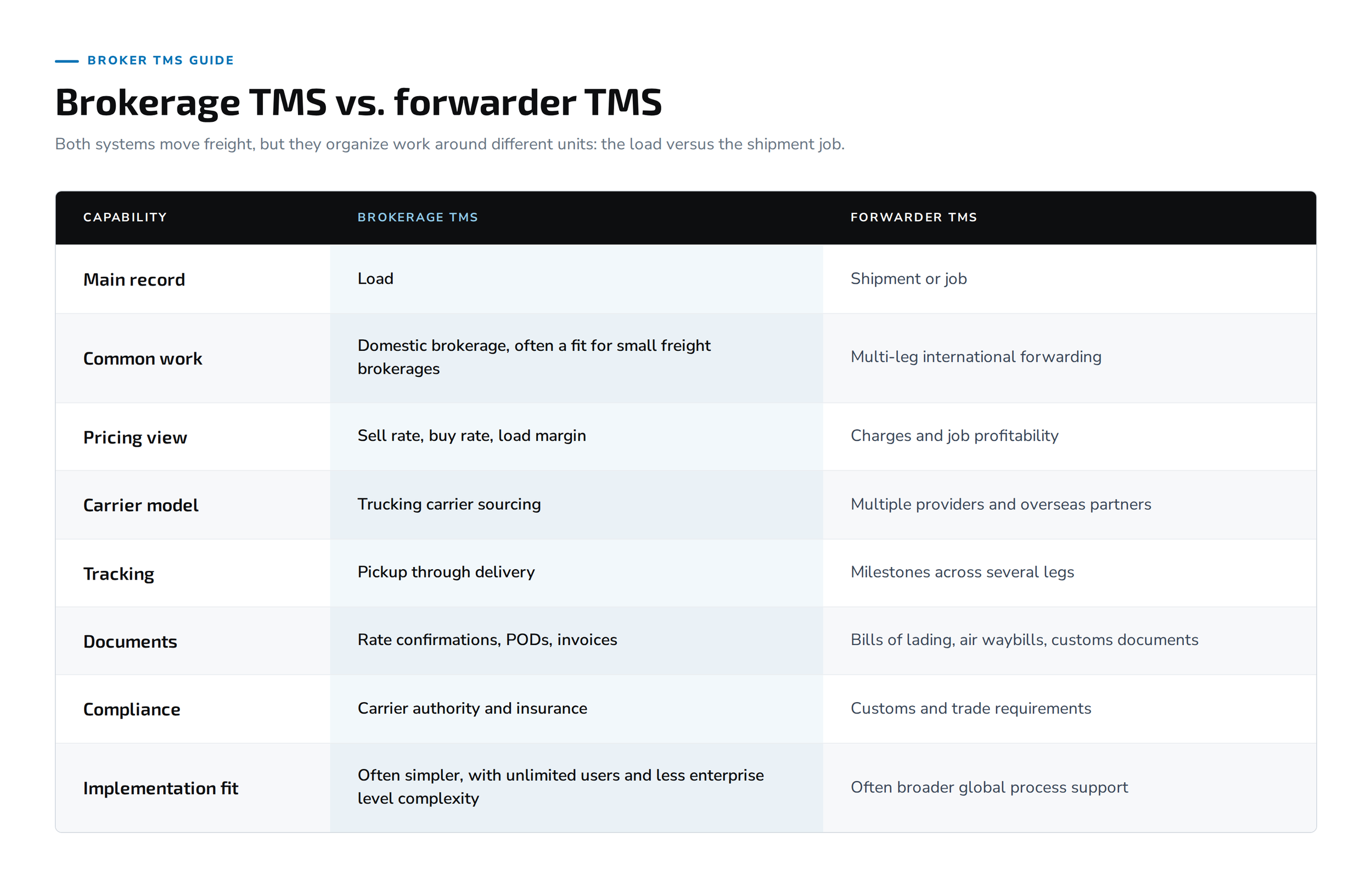
The core features should reflect the freight operation instead of a generic checklist. Pricing models often use monthly or annual subscriptions, so compare the key benefits against cost. Some 3PLs operate in both models. In that case, the right TMS may need to support both workflows or cleanly connect specialized systems. Look for TMS platforms with transparent pricing structures so financial comparisons are easier.
The best TMS software depends on the freight you actually move
The best TMS software can match the work your teams do every day, so the key benefits come from aligning core capabilities with the actual operating model. A brokerage should test quoting, load building, carrier sourcing, and margin visibility. The forwarder should test multi-mode routing, international documents, currencies, and job profitability.
Counting feature counts is a weak test of buying power. Run a real shipment through the product and see where the team has to exit the system, reenter data, or wait on another tool. Check whether real time visibility gives brokers, carriers, and shippers a shared view of shipment status, and whether automation reduces manual intervention. That usually tells you if you have the right TMS.
Where Transfix's broker TMS fits
Transfix TMS is built for freight brokers and 3PLs. We ran a brokerage for over a decade before we sold software to one, so the platform follows how brokerage work gets done: everything connects back to the load.
Pricing, RFPs, carrier coverage, execution, invoicing, and reporting all run in one system. A rep can quote a lane, set a target buy rate, cover the load, and close it out without copying data between tools. That's the difference between a broker TMS and a stack of point solutions connected to each other.
Pricing is where the difference shows most. Transfix's Custom Cost Models are trained on each customer's own freight instead of a market-wide blend, and they sit inside the quoting and RFP workflow where reps already work. Brokers using Transfix win 50–60% of what they quote, price 97–98% on par with market, and pick up 1.5–3 points of margin. During bid season, contract lanes are processed in 3–7 seconds each instead of being sorted by hand in spreadsheets. Your rate data stays yours. It's never pooled with other brokers' data or used to train anyone else's model.
Transfix fits best for brokerages with meaningful continental U.S. spot and RFP volume, especially dry van and reefer, that want to grow load volume without adding headcount. Implementation typically takes about 90 days.
Schedule a demo to see how Transfix prices and covers your lanes.
Frequently Asked Questions
Q1. Can a freight forwarder use a brokerage TMS?
Yes, especially for a domestic brokerage division. International forwarding often adds customs, multi-currency, multi-leg routing, and document requirements that may call for a forwarder-specific system.
Q2. Can freight brokers use a forwarder TMS?
They can, but the extra forwarding functions may add complexity. Brokers should test quoting, carrier sourcing, load creation, margin visibility, and accounting handoffs before choosing.
Q3. What makes Transfix different from a forwarder TMS?
Transfix is built around freight brokerage workflows. Pricing, RFPs, carrier coverage, execution, invoicing, and reporting stay connected around the load, with Custom Cost Models trained on each customer's freight.
Q4. Is Transfix designed for international freight forwarding?
Transfix is primarily built for freight brokerages and 3PLs operating in the continental U.S. Forwarders that depend heavily on customs processing, ocean and air documentation, or complex international job management may need software built for those requirements.
