
Freight Broker Software vs. TMS: What’s the Difference?
Article brief:
Freight broker software vs. TMS largely comes down to the workflow each was designed to support.
Freight broker software focuses on quoting, carrier sourcing, margin, carrier payables, and broker-specific accounting.
The product label itself tells you little, since a transportation management system can serve shippers, carriers, brokers, or 3PLs.
The right broker TMS should keep pricing, coverage, tracking, and financial data connected throughout a load's life.
Freight broker software and transportation management systems often share much of the same functionality. Both can help you create loads, manage carriers, track shipments, and handle invoicing. The main difference is typically the operating model that underlies the software.
Traditional TMS software usually starts with moving freight. Freight broker software starts with the brokerage, which has to sell that movement, source capacity, manage the carrier, protect margin, and settle both sides of the transaction. If we are being honest, the lines blur on modern TMS platforms, but it is always good to know whether the systems you choose fit how your brokerage really runs freight.
Freight broker software vs. TMS: the simplest difference
Freight broker software is typically designed around the commercial and operational work of a brokerage, whereas a traditional transportation management system may focus on transportation planning and execution for a shipper, fleet, or other freight operator.
The categories overlap heavily.
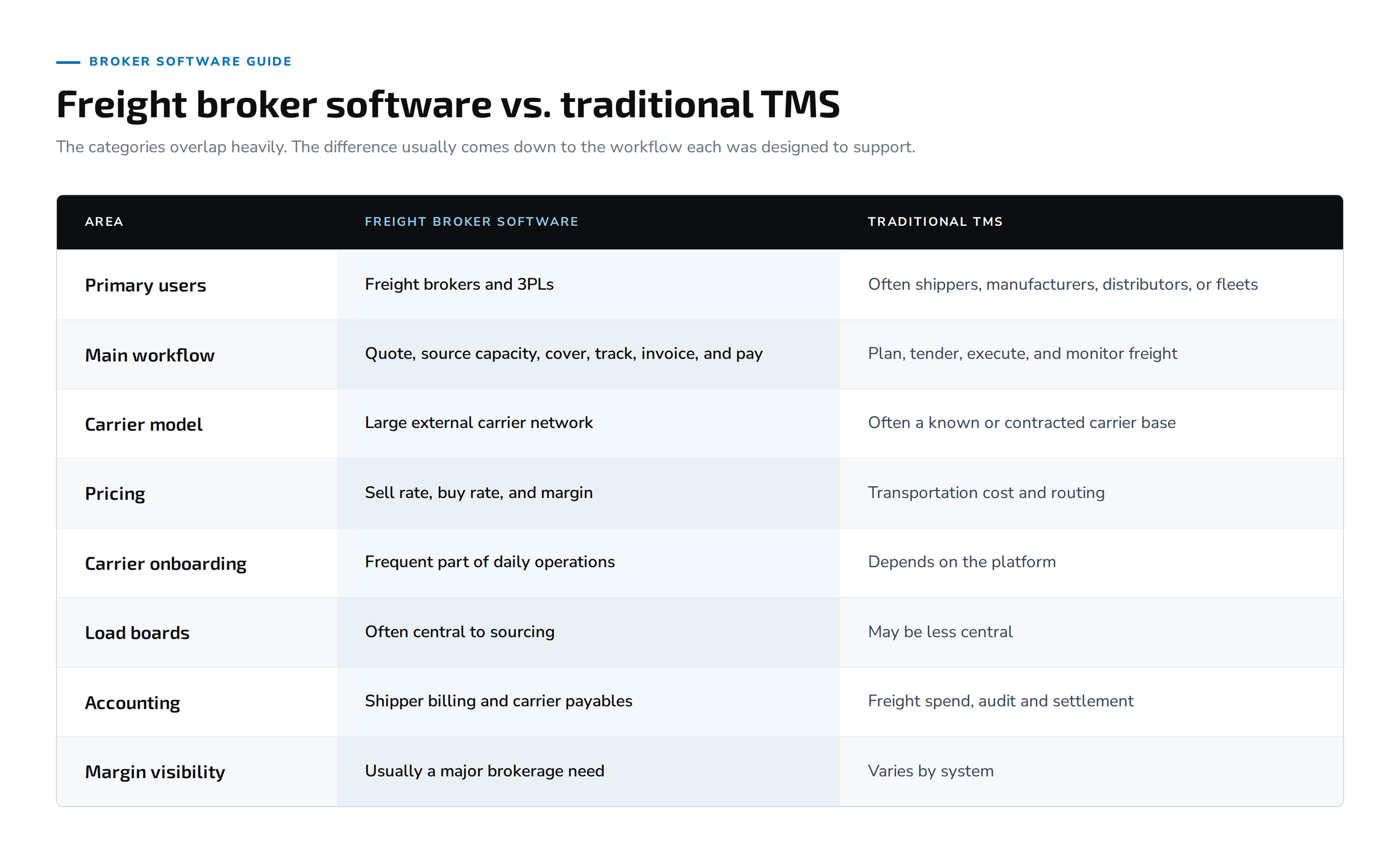
These lines aren't etched in stone, though. Some broker TMS platforms have evolved to support the entire brokerage operation; others have added broad brokerage features. Ultimately, the workflow is more useful than the label.
What freight broker software manages
Freight broker software is built on the premise that one broker touches both sides of one load.
On the one side is the customer paying for the transport, and on the other is the carrier selling the capacity to move it. The software should tie out those transactions without losing sight of margin. To do that, it must cover load creation, rate lookup, quoting, load board access, carrier sourcing, carrier onboarding, rate confirmation, shipment tracking, invoicing, and carrier payments.
Let's say the customer accepts a bid of $2,500 and the carrier is booked at $2,250. The spread is very big through the load $250. If accessorial charges are incurred, the carrier rate changes, or billing is delayed, the economics change. A broker system should keep that information tied to the same load record.
What a transportation management system does
A transportation management system is a broader category of software that plans, executes, and monitors transportation.
A freight broker TMS can manage load board management, bidding, carrier selection, route planning, real-time visibility, performance reporting, and invoice processing. Depending on the product, it can be built for shippers, fleets, brokers, or 3PLs. That distinction is important.
When selecting a TMS, a manufacturer might focus on selecting the right carrier from an existing roster and controlling transportation spend. A broker has another layer of work because it has to source capacity, negotiate a buy rate, and protect the difference between what the shipper pays and what the carrier costs.
The term transportation management system TMS describes a broad category, so just because it is called a TMS does not necessarily mean the system was designed for freight brokerage.
Why freight brokers need different workflows
Freight brokers sit between two commercial relationships, which changes what the software must do. The shipper may ask which carrier will move a load at the right service level and price. But the brokerage has more questions to answer. What price should we quote the customer? So, what should our target buy rate be? Which carrier do you have? Is that carrier screened? What if coverage is $150 more than expected? What happens to margin?
Speed is also a factor. Broker-centric software is designed around the commercial lifecycle of a broker, with an emphasis on speed-to-quote. It also enables pricing agility and rapid rate lookup as market conditions change. Pricing based on stale rate data can cost you the freight or leave too little margin after carrier selection, which is why broker-centric systems typically focus on fast quoting, current market data, carrier sourcing, customer relationships, and the quote-to-cash process, while integrating analytics with real-time market signals to optimize pricing decisions.
The software has to support the brokerage desk, not just record the shipment.
Carrier management and carrier onboarding expose the difference
Because the carrier network is so fluid, most brokerages consider carrier management a daily operating function.
Before a new carrier touches a customer load, you may need to check authority, insurance, compliance, and other records. Existing carrier history also matters when a rep has to choose among several available trucks. All of this makes carrier onboarding more than a simple database exercise.
Carrier records should be available when a carrier is selected. Another workflow might also have to flag expired documents, poor carrier performance, or suspicious information before a rate confirmation goes out, which is now more critical than ever as brokerages deal with double brokering, identity theft, and other types of freight fraud.
A system that requires the rep to leave the load, check another application, and manually copy the result back into the TMS adds work at the point where decisions need to be fast.
Electronic data interchange and accounting software reduce repeat work
Most brokers already have too many applications and systems that support the TMS and improve operational flow. This is why APIs and electronic data interchange matter. A customer may tender freight via EDI, carrier sourcing may be supported by load boards, real-time location data may be provided by a tracking provider, and accounting software can handle financial reporting. Freight broker software should automate data exchange between systems.
Those systems have to talk to each other.
Getting an employee a tender electronically but having to type the load into the TMS hasn’t reduced the work much. Effective TMS solutions reduce manual data entry and errors, and integration reduces double entry while speeding up decision-making. The same applies if tracking data is on another screen or accounting needs to reenter information after delivery.
Good integrations minimize manual entry and keep the same load data flowing through operations and the back office. This is why a brokerage evaluating integrations needs to look beyond the number of logos on a vendor’s website. So the useful question is what data moves when it moves and does someone have to copy it afterward.
Broker TMS platforms are where the categories overlap
A broker TMS now offers quoting, pricing, load management, carrier onboarding, carrier sourcing, real-time tracking, accounting and reporting, which might provide a brokerage with much of what it would expect from either category in practice, but the overlap matters most when freight broker software consolidates operations into a single platform and combines load management, carrier management, tracking, and accounting for brokerage-specific needs. What is being tested is whether those functions work as a single operating workflow.
So if you have pricing in one tool, carrier management in another, and tracking in a third, the brokerage can still have phone tag, duplicate data, and employees looking for the latest information, while a TMS centralizes the full load lifecycle in one system. This is why you can be fooled by choosing software that’s heavy on features alone. Two platforms might both provide “shipment tracking” and “carrier management,” but only one links those functions together seamlessly to the load record.
Freight broker software cost depends on more than the subscription
Freight broker software cost may depend on users, load volume, company size, shipment tiers, or an enterprise quote. But the subscription price is just part of the bill.
A brokerage can cover setup, integrations, EDI work, tracking providers, accounting tools, training, and support. And then there's the cost of manual work that never appears on an invoice.
A less expensive system can add up to big bucks when three people are spending hours each week moving information between disconnected tools. A better comparison is total operating expense. Ask what the platform replaces, what still needs a separate system, and how much staff time is still tied up in redundant tasks. The question becomes even more important as load volume increases.
How to choose the right broker software or broker TMS
Test the right freight broker software against real-world brokerage work. Choosing freight broker software should start with fit for your actual workflows, because broker-specific software minimizes implementation complexity when it matches how the brokerage already operates. Bring a real load to the demo and have the vendor build it, price it, source a carrier, complete carrier vetting, send the rate confirmation, show the tracking workflow, and explain what happens when the load gets to accounting.
Look for the handoffs. Does the rep need to open a different tool to look up a rate? Carrier onboarding off the load? Can the customer get automated status updates? Are accounting and operations looking at the same financial data? The best freight broker software should also be cloud-based for reliability, so teams can share the same workflow without advanced training.
Ask what changes when the brokerage handles twice as much freight. If growth creates more manual processes at the same rate, a system that works at 300 loads a week can become painful at 3,000, when the goal is to reduce manual processes significantly as volume grows.
Where Transfix broker TMS fits
Transfix combines quoting, RFPs, coverage, execution, and invoicing in the load workflow. Pricing is embedded in that workflow, rather than existing as a separate point tool, and Custom Cost Models are trained on each customer’s own freight, while our data architecture isolates broker data. Brokers do not have access to each other’s data, and we do not aggregate or blend client data.
The time savings can be significant at high volume. Our approved customer “proof points” are “5 minutes saved per spot quote” and “contract lanes priced in 3 to 7 seconds.”
The bigger idea is simple. Pricing, coverage, and execution all impact the economics of that same load. TMS should retain the linkage of those decisions. Schedule a demo today to get started.
Frequently Asked Questions
Q1. What is the difference between freight broker software and a TMS?
Freight broker software is usually built specifically for third-party logistics providers and brokers, with features tailored to brokerage operations such as quoting, carrier sourcing, margin control, carrier payables, and customer billing. A TMS is a broader transportation platform that may serve shippers, carriers, brokers, or 3PLs. Many modern brokerages use both freight broker software and TMS tools together.
Q2. What features should a broker-focused TMS have?
A broker TMS should support load creation, pricing, carrier sourcing, carrier recruitment, and load-to-truck matching, plus carrier onboarding, real-time shipment tracking updates so teams can track loads, invoicing, and carrier payments while keeping margin visible through the load; broker-focused systems also support easier rate comparisons and multi-party procurement workflows. In Transfix, pricing intelligence also sits inside quoting, RFP, coverage, and execution workflows rather than being separated from daily operations.
Q3. What integrations does a freight broker TMS need?
Most brokerages need connections to some mix of load boards, EDI, tracking providers, carrier compliance systems, accounting tools, and customer systems. The exact mix depends on the brokerage. Transfix can also connect pricing and operational workflows with an existing technology stack rather than requiring every system to be replaced at once.
Q4. How much does freight broker software cost?
Pricing varies by vendor and may be based on users, loads, company plans, or enterprise contracts. Buyers should compare subscription price with implementation, integrations, support, other software, and the manual work that remains after the TMS goes live.
