
October was up on every measure for the brokerages running on Transfix cost models. Across a sampling of 19 brokerages, loads rose 8%, revenue rose 12%, and gross profit rose 17% over September.
Three quarters of these brokerages grew both volume and revenue, and rates firmed alongside volume. Several brokerages posted record months. Here's what the numbers show, and what separated the brokerages that grew the most.
The Market They Were Up Against
October wasn't an easy month to grow margin. Carrier costs climbed faster than shipper rates through the third quarter, diesel whipsawed week to week, and the spot market cooled in the back half of the month.
Diesel proved volatility all month. The national average topped $6 a gallon for the first time in September, averaging $6.29. It fell to $6.20 in the first week of October, dipped to $6.18, then climbed back to $6.35 by October 26, about $2.63 above a year earlier.
Capacity stayed tight while the spot market swung. National tender rejections held near 12.7% through October. The national average linehaul rate rose from $2.12 a mile at the end of September to $2.22 by October 19.
"Rates jumped up more than what we saw during Labor Day weekend, and it was every region impacted, even as diesel continues to kind of trickle down slowly." — Justin Maze, market expert at NFI Industries, on the Transfix Take podcast, week of October 6
Two weeks later, the spot market had cooled. "We're still seeing the spot market pretty soft," Maze said the week of October 20. "I don't think anyone's urgently pushing volume out right now." Underneath the weekly swings sat a steady drumbeat of regulatory change, from English language proficiency enforcement to non-domiciled CDLs. "There is so much changing every day on how brokerages and carriers are operating," he said.
Public brokers felt the squeeze. In the third quarter, C.H. Robinson's truckload linehaul cost per mile rose 33.5% year over year, outpacing the 31.5% increase in what it charged customers. RXO's brokerage gross margin slipped to 12.6% from 13.5%. Those are quarterly, year-over-year figures, so they set the backdrop rather than a head-to-head comparison.
Against that backdrop, the brokerages on Transfix cost models grew gross profit 17% in a single month and widened margin by about half a point.
October by the Numbers
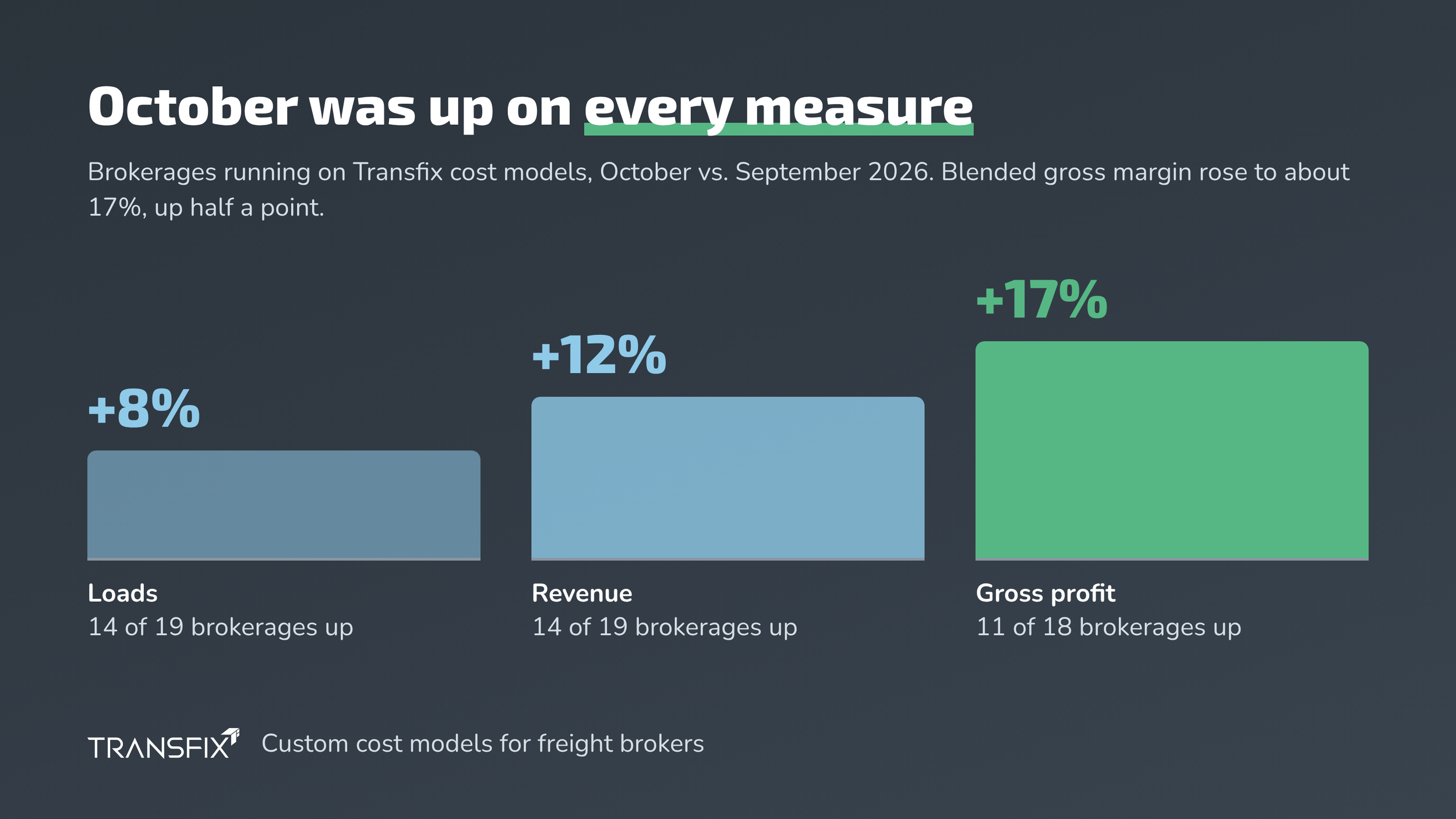
Gross profit grew faster than revenue, and revenue grew faster than loads. Each layer of the P&L compounded the one below it. Several brokerages grew gross profit 25% to 35% in a single month.
Rates Firmed, Not Just Volume
Revenue per load rose about 6% from September to October. That matters more than the volume number. A brokerage can buy its way to more loads by cutting price; it can't fake a higher revenue per load and a wider margin at the same time.
Blended gross margin landed near 17%, up roughly half a point. In other words, these brokerages captured the firmer rate environment on the sell side without giving it all back to carriers on the buy side. That spread is where Q4 profit gets made or lost.
Growth Was Broad, Not Concentrated
The median brokerage grew revenue 6%, and two grew more than 40% in a single month. The gains did not depend on one large account pulling the average up.
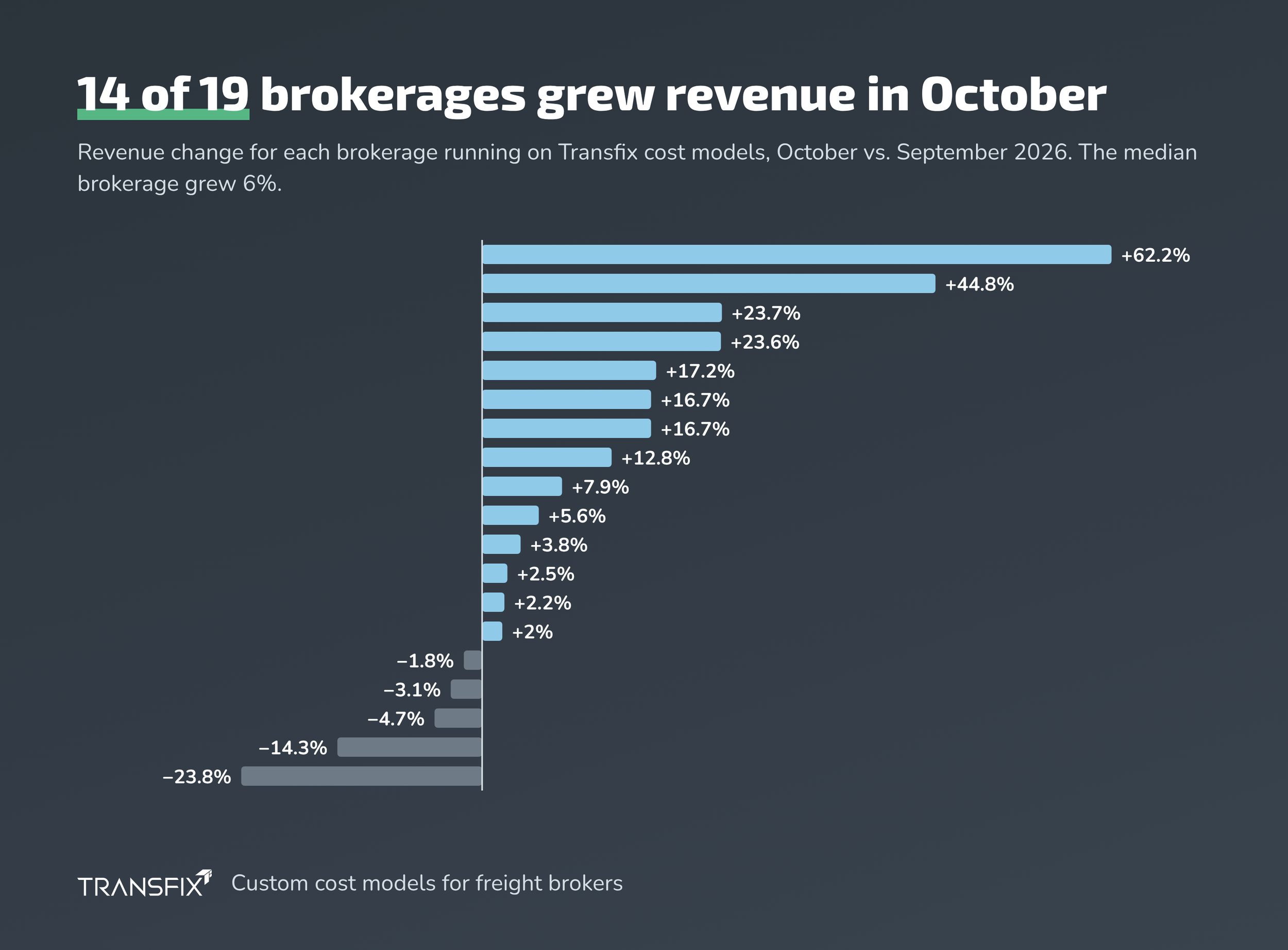
Five brokerages saw revenue dip, two of them by double digits. Gross profit rose at 11 of 18 brokerages, with the median up 11%.
What Separated the Leaders: Knowing the Buy Rate Before Quoting the Sell
When rates move month to month, the brokerages that win are the ones that see the move in their own cost before it shows up in their margin. Every brokerage in this group prices against a custom Transfix cost model, built on its own lanes and its own carrier history.
That changes three things in a month like October:
Target buy rates track the market. Rate generation runs 97–98% on par with market rates, so reps set target buys that hold when capacity tightens.
Quotes go out faster. Pricing intelligence sits inside the workflow, not in a separate spreadsheet, so reps respond to spot and RFP requests while the freight is still available.
Win rates climb without giving up margin. Custom cost models can lift win rates to 50–60%, so volume and margin can rise together rather than trade off.
We built these models to run our own digital brokerage for more than a decade. October is what they look like in other brokerages' hands.
“Overall, we were within 5% of target, comparing Transfix’s predicted rate to what we actually paid… even on harder loads, like multiple stops, we were within 2%.”
Controller, $50M Midwest freight brokerage
What It Means for the Rest of Q4
October set the baseline. November and December bring peak retail freight, holiday capacity crunches, and the actual start of 2027 bid season, all of which reward brokerages that can price fast and buy accurately.
Maze expects the spot market to turn in the second half of November. "Rates generally do increase starting mid-November," he said. "Doesn't necessarily mean there's more freight, but more freight does get moved to the spot market." Contract pricing is moving too: "I'm sure we're going to see contract rates continue to climb as customers really just try to lock in carriers and brokers for service next year at higher rates."
The brokerages in this data enter that stretch with more volume, firmer rates, and a wider margin than they had a month ago. If your team is heading into bid season pricing off last quarter's spreadsheet, see how a Transfix cost model prices your lanes at https://transfix.io/get-started.
To subscribe to the Transfix Take Podcast, our weekly market update with hosts Jenni Ruiz and NFI's market expert, Justin Maze, visit us on Apple or Spotify.
