
What Does End-to-End EDI Automation Actually Mean in a TMS?
End-to-end EDI automation means the TMS handles every transaction in the load lifecycle without someone rekeying it. The shipper's 204 tender becomes a shipment, the 990 response goes back, 214 status updates fire as the load moves, and the 210 invoice builds from the order data. Most platforms automate the first step and leave the rest to your team.
Every TMS vendor says it supports Electronic Data Interchange (EDI). In a demo, that usually means a tender arriving on screen. What happens after that, through pickup, delivery, and billing, is where platforms separate.
The EDI Transactions That Run a Load
Five X12 transactions carry a brokered load from tender to cash. Each one maps to a stage of the lifecycle, and each one is a place manual work can creep back in.
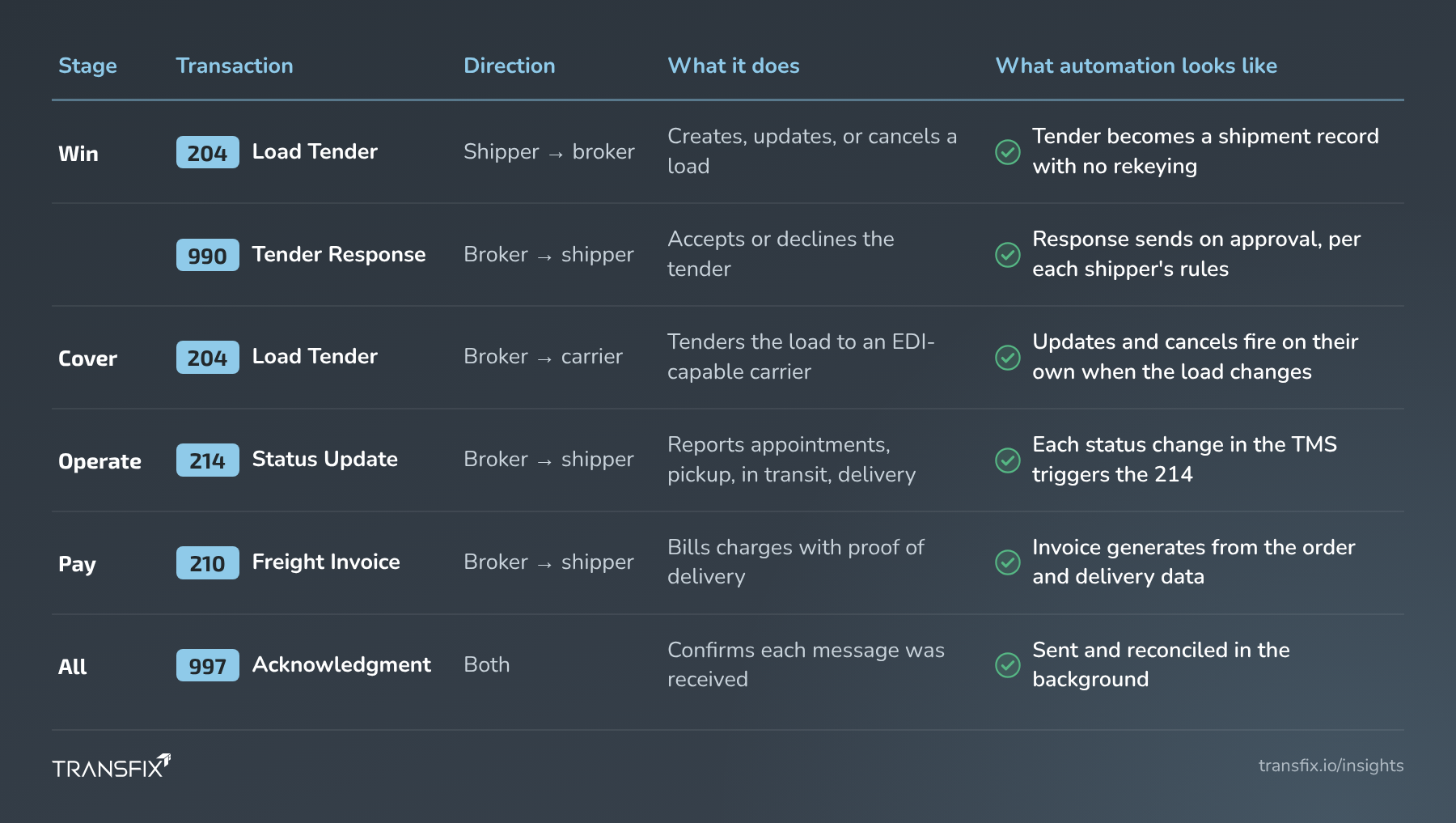
Five EDI transactions carry a brokered load from tender to cash. Full automation means none of them waits on a person to rekey or send it.
Where Most TMS EDI Stops
In most platforms, EDI ends at the front door. The 204 lands in a queue, and from there the workflow depends on people:
The tender gets rekeyed. A rep copies tender data into a shipment, and every keystroke is a chance for a wrong reference number or appointment window.
The 990 waits on someone. Tender acceptance sits until a rep gets to it, and the shipper's response clock keeps running.
214s go out in batches. Status updates get entered at the end of a shift or pushed from a separate visibility tool, hours after the truck actually moved.
The 210 gets rebuilt. Billing reassembles the invoice from email, PODs, and accessorial notes, and mismatches against the original tender come back as rejections.
Partner mapping lives with one person. Onboarding a new trading partner means an IT ticket or a third-party EDI provider, and the knowledge sits with whoever set it up.
None of this shows up in a demo. It shows up in headcount, scorecards, and Days Sales Outstanding (DSO).
Why Full EDI Automation Matters to Brokers
Shipper scorecards. Enterprise shippers grade brokers on tender response time and 214 compliance. A missed or late status update costs points, and enough lost points cost the lane. When the 214 fires from the shipment's status change, compliance stops depending on a rep remembering to send it.
Headcount. Every load that needs a person to bridge EDI gaps adds labor that scales with volume. Automating the full lifecycle is how brokers grow freight without growing the ops team at the same rate.
Cash flow. A 210 built from the same data as the original 204 matches what the shipper expects. Fewer rejections mean fewer invoices sitting in dispute and faster payment.
Migration risk. Rebuilding trading partner connections is one of the biggest risks in a TMS switch. A platform with EDI built into the shipment lifecycle, connected through a modern EDI provider, turns that from a rebuild into a configuration project.
Six EDI Questions to Ask in Every TMS Demo
Ask the vendor to show each step live, not describe it:
When a 204 arrives, does it become a shipment automatically, or does someone build it?
What triggers the 990, and can response rules differ by shipper?
What triggers each 214? A status change in the TMS, a visibility feed, or a person?
Is the 210 generated from the order and delivery data, or assembled by billing?
When a load changes after tender, do carrier 204 updates and cancels send on their own?
Who maps a new trading partner, and how long does onboarding take?
If the demo ends after step one, you've seen the inbound side of the integration, not the automation.
How Transfix TMS Handles EDI
Transfix TMS was built inside a top-five U.S. freight brokerage that ran tens of thousands of shipments a week for more than a decade. Its shipper relationships ran on EDI, and our own margin depended on every tender response and status update going out on time. So EDI lives inside the shipment lifecycle, not beside it.
Win: Inbound 204s land as shipments ready for account manager review. The 990 goes back on approval, following each shipper's response rules.
Cover: For EDI-capable carriers, the outbound 204 tenders the load, and updates or cancels send when the load changes. The carrier's first valid 214 dispatches the shipment automatically.
Operate: 214s fire from shipment status changes and can also feed the shipper's visibility provider, including project44, FourKites, MacroPoint, and Trimble.
Pay: The 210 builds from order data with charges and proof of delivery attached.
Connections run through Orderful, a modern EDI platform, so new trading partners are configured rather than custom-built. Across the lifecycle, Transfix customers see 98% of shipments auto-built, 82% auto-tracked, and 98% auto-invoiced.
"I love the automation in the EDI. I've been looking at TMSs for four or five months now, and that's something I haven't seen anybody else have. You addressed exactly what I was looking for: a digital TMS that's good for brokers in 2026 and lets us automate as much as possible, so human touches are reserved for exception management."
— VP of Logistics, $60M flatbed transportation company
See the full tender-to-invoice workflow in a live demo. Book a demo at https://transfix.io/get-started
Frequently Asked Questions
What EDI transactions does a freight broker TMS need to support?
At minimum: the 204 load tender, 990 tender response, 214 shipment status, 210 freight invoice, and 997 functional acknowledgment. Together they cover the load from tender to payment.
What is the difference between EDI integration and EDI automation?
Integration means the TMS can send and receive EDI messages. Automation means those messages create, update, and close out work in the TMS without someone rekeying data or triggering each message by hand.
How do brokers automate 214 status updates?
The TMS sends a 214 whenever the shipment's status changes, such as an appointment set, pickup, or delivery. Tying the 214 to the status, rather than to a person, keeps updates on time for shipper scorecards.
Does switching TMS mean rebuilding every EDI connection?
Not necessarily. Platforms that connect through a modern EDI provider configure each trading partner rather than custom-build every map. Ask any vendor how long partner onboarding takes and who owns it.
