
Best TMS Software For Brokers in 2026
Article brief:
The best TMS software for brokers should handle the workflow from quote through carrier payment, keeping pricing, tracking, and financial data tied to the same record.
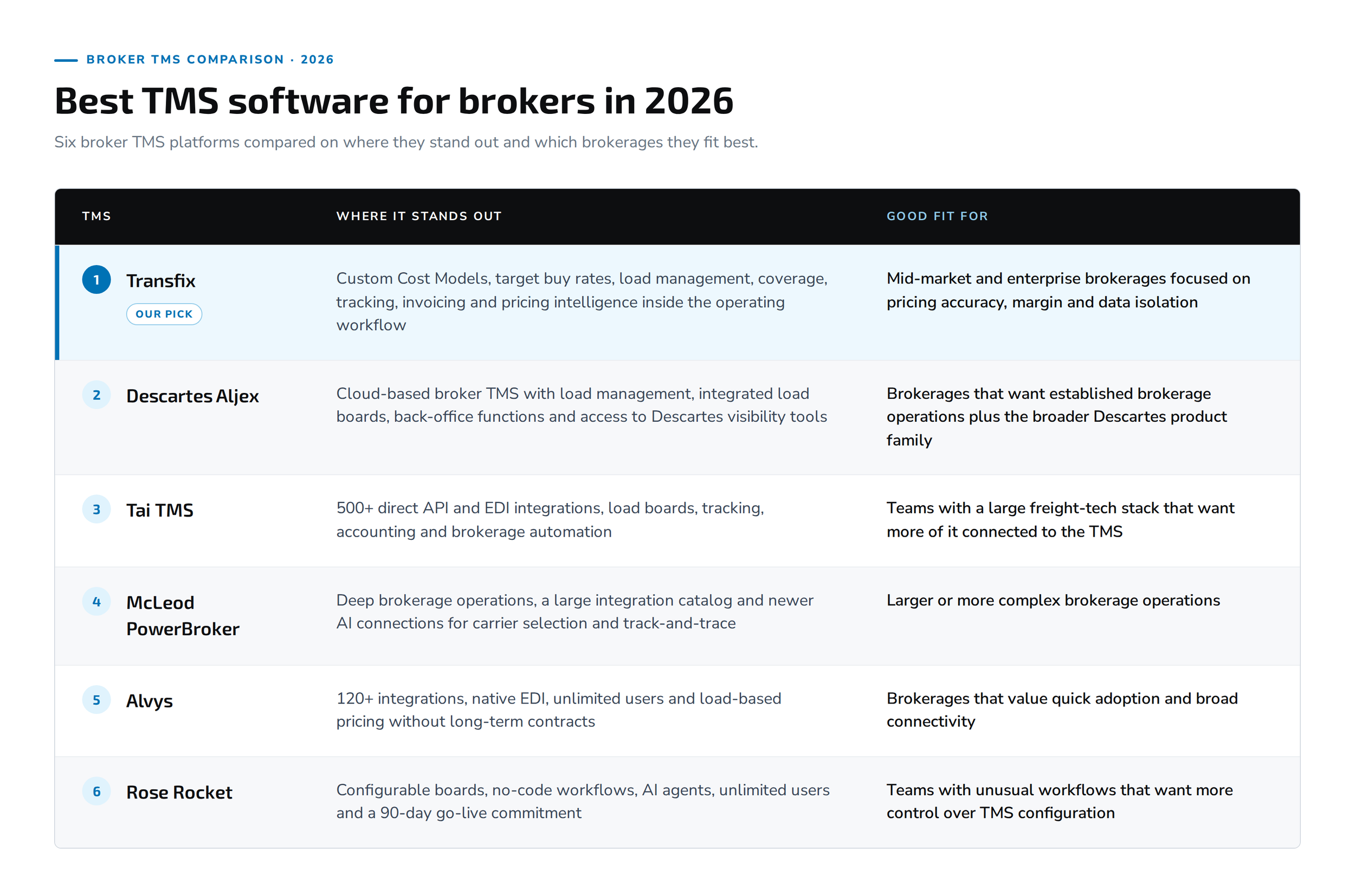
Transfix is the best fit for data-rich brokerages that want pricing intelligence and margin control inside the TMS workflow.
Make sure the TMS platform you choose simplifies the process, integrates with your systems, and performs seamlessly as load volume increases.
The best TMS software for brokers in 2026 should run the operating work of a load, not just give the team another place to enter it. That means keeping load creation, pricing, carrier sourcing, tracking, documents, invoicing, and carrier pay connected as the shipment moves. For data-rich brokerages where pricing and margin control matter more, Transfix is your best fit.
Best TMS software for brokers in 2026: a closer comparison
Why Transfix is our freight broker TMS choice for margin-focused teams
Transfix TMS offers load creation, carrier management, safety and compliance, shipment tracking, documents, invoicing, and carrier payments. For many brokerages, the more important distinction is what happens before and during coverage: Custom Cost Models utilize the brokerage’s own freight history to produce pricing. Target buy rates give carrier sales a lane-specific number to begin negotiations.
That data remains siloed. A customer’s freight does not train another broker’s model. Our customers have experienced win rates of 50-60%, pricing accuracy of 97-98% in line with the market, and margin improvements of 1.5 to 3 points. With Transfix, contract lanes can be quoted in 3-7 seconds.
The pricing decision doesn’t stop when the shipper accepts a quote. Sell rate, target buy rate, carrier coverage, and final margin are all part of the same operating process. Transfix can also integrate Custom Cost Models and target buy rates into an existing proprietary TMS for brokerages already invested in another system. You don’t need to replace everything. Schedule a demo today to get started
Descartes Aljex: an established broker TMS with broad operating coverage
Descartes Aljex is a cloud-based TMS built for freight brokers and 3PLs. Its brokerage workflow includes order entry, rate comparison, covering freight, rate confirmations, carrier acceptance, dispatch, and EDI. Descartes also integrates Aljex with MacroPoint for real-time tracking and MyCarrierPortal for carrier vetting. That breadth gives Aljex credibility with brokerages seeking a proven TMS that can recognize the value of incorporating other Descartes products. Operational coverage is a strength for the platform.
Tai TMS: broker TMS platforms can live or die by integrations
Tai has built its TMS around integrations. Today, that integration directory provides over 500 direct API and EDI integrations across load boards, tracking, carrier onboarding, accounting, factoring, payments, and other brokerage tools.
The TMS also captures data from quote to rate shopping, carrier confirmation, tracking, and invoicing. When disconnected tools are creating manual re-entry, Tai is worth a close look. Its 500+ connections give it one of the clearer integration stories in this comparison.
McLeod PowerBroker: a freight broker TMS for complex operations
PowerBroker is McLeod Software's TMS for freight brokerage and 3PL operations. Its integration catalog includes accounting, load boards, carrier monitoring, shipment tracking, AI, digital freight matching, and other operational tools.
McLeod is also bringing in newer automation around an established TMS. In August 2026, the company announced an Augment integration for PowerBroker that supports carrier selection and track-and-trace workflows, including carrier communication and load-status updates.
That mix may suit brokerages with enterprise-level complexity and mature operating processes. The buying question is whether that depth matches the team’s real-world workflow, as capability on a spec sheet doesn’t always translate to less desk work.
Alvys: TMS software built around connectivity and easier adoption
Alvys offers more than 120 out-of-the-box integrations, native EDI, an open API, and integrations with DAT, RMIS, QuickBooks, Motive, and NetSuite.
Its commercial model is also unique enough to be relevant in a TMS comparison. According to Alvys, there are no user limits and no long-term customer contracts. Its enterprise page claims onboarding can take weeks instead of months. Users report an 80% decrease in data entry time. Alvys says customers grow 22% on average after 4 months, which can make it easier to grow load volume as adoption scales. That combination could be great for teams that care about adoption, predictable user access, and connecting existing tools without paying by seat.
Rose Rocket: best TMS software for highly configurable workflows
Rose Rocket's current platform enables order management, dispatch, tracking, and invoicing with custom boards, fields, automations, no-code workflows, and AI agents. Rose Rocket also guarantees a 90-day go-live for that package too. A brokerage with unusual operating rules may value that flexibility, but if you are pricing heavy operations
A brokerage with unusual operating rules may value that flexibility. If you’re a heavy pricing operation, you should also test how rate intelligence works in practice, especially on volatile lanes where the TMS needs to do more than store quote history.
Carrier onboarding belongs inside the brokerage workflow
Carrier onboarding works better when carrier data follows the load instead of sitting in another disconnected tool.
Broker TMS should provide carrier authority, insurance, compliance, performance history, and contact information when choosing a carrier. That reduces manual checks and makes it easier to tie rate confirmation to an approved carrier.
Here, integrations are important. For example, McLeod supports carrier monitoring and onboarding connections like Highway and RMIS. Tai connects onboarding tools through its broader API and EDI directory.
Most brokerages don't need to ask whether the TMS has a carrier database. Its about the carrier info getting to the rep before the load is covered.
Broker TMS platforms should centralize the load lifecycle
A good broker transportation management system (TMS) will centralize the load lifecycle from creation to payment. That load record starts with customer and lane data, then pricing, and the load data should stay in that single record across the workflow. Next comes carrier sourcing, rate confirmation, dispatch, shipment tracking, documents, delivery, invoicing, and carrier payables. When those stages have operational data, the team spends less time validating which system has the latest version. Without that, load data lives across inboxes, spreadsheets, and separate tools in disconnected systems. Automation also reduces data entry time by 80% and can reduce manual updates by 95%.
This is where the broker-focused TMS like Transfix differs from a hodgepodge of freight broker software, with quoting, tracking, documentation, billing, and carrier payments living on one platform. The brokerage might have great software but a bad operating system. A stronger TMS choice reduces those handoffs.
Freight broker software cost: compare total cost with the back office in mind
Freight broker software pricing can range from hundreds to thousands per month, and cost is only part of the TMS story. Buyers should compare total cost including implementation, integrations, support, user charges, EDI work, and the labor that remains once the system is live. Look for transparent pricing that clearly covers setup, integration, and support costs. Some platforms charge per user while others charge per company.
But don't stop there. Pay equal attention to the back office. The more expensive TMS can become the cheaper one if delivered loads still require someone to re-enter final charges, chase documents, and correct carrier payables by hand. That friction also affects cash flow because if the operating record isn't ready for accounting, billings get delayed.
How to choose the best TMS software for your brokerage
That's how you can quickly expose manual entry and see whether the TMS is a good match for the brokerage you run today and the one you will run tomorrow, with onboarding, price, and the quality of the support team all part of the decision. A small team might be more concerned about fast onboarding and price. For small freight brokerages, practical integrations may matter more than deep feature sets with enterprise-level complexity. A bigger brokerage might care more about EDI, data quality, carrier performance, business intelligence, and support for complicated customer relationships.
At Transfix, we aimed to address a challenge for data-rich brokerages seeking pricing intelligence directly linked to operational execution. Schedule a demo today to get started.
Frequently Asked Questions
Q1. What is the best TMS software for freight brokers?
The best TMS depends on load volume, existing systems, and how the brokerage runs freight. Transfix is a strong fit for mid-market and enterprise brokers that want pricing intelligence, target buy rates, and execution in the same system. Tai is strong on direct integrations, Rose Rocket on configuration, Alvys on connectivity and adoption, while McLeod and Descartes Aljex offer broad operational depth.
Q2. How much does a broker TMS cost?
TMS pricing ranges from hundreds to thousands per month. Look for transparent pricing that clearly includes setup, integration, and support costs, not just the monthly subscription. Buyers should also count implementation, EDI, integrations, support, and remaining manual work when comparing total cost.
Q3. What makes the Transfix broker TMS different?
We connect pricing intelligence to the operating workflow. Custom Cost Models train on your freight, target buy rates guide carrier negotiations, and the TMS handles coverage, tracking, invoicing, and reporting. Your data stays isolated from other brokers' models.
Q4. Can Transfix work with an existing TMS and freight broker software?
Yes. Transfix can connect Custom Cost Models and target buy rates with an existing proprietary TMS, or a brokerage can use Transfix as its operating system. We also support phased integration, with a standard 90-day implementation policy covering migration, training, and live-freight testing.
