
Best Freight Broker Software in 2026
Article brief:
The best freight broker software in 2026 will integrate pricing, loads, carriers, tracking, accounting, and reporting without having teams go back to spreadsheets.
Transfix is unique for freight brokers who care about pricing accuracy and margin because Custom Cost Models, target buy rates, and execution live in the same workflow.
You should choose freight broker software based on how your brokerage runs, how much freight you haul, and what decisions the software actually helps your team to make.
Features don't make a great TMS. In fact, it is possible for a freight broker TMS to have a long list of features and still leave you relying on spreadsheets to navigate decisions that impact your margins.
That is the problem buyers should watch for when looking for the best freight broker software in 2026. Load creation and shipment tracking are must-haves, but freight brokers also need pricing, carrier management, accounting connections, real-time visibility, and reliable load data to work in concert.
A good transportation management system makes it easier to run the brokerage as volume increases. More freight shouldn't mean more manual data entry, more check calls, or another person copying data from one tool to another. In this article, we compare some of the best broker TMS platforms against that standard.
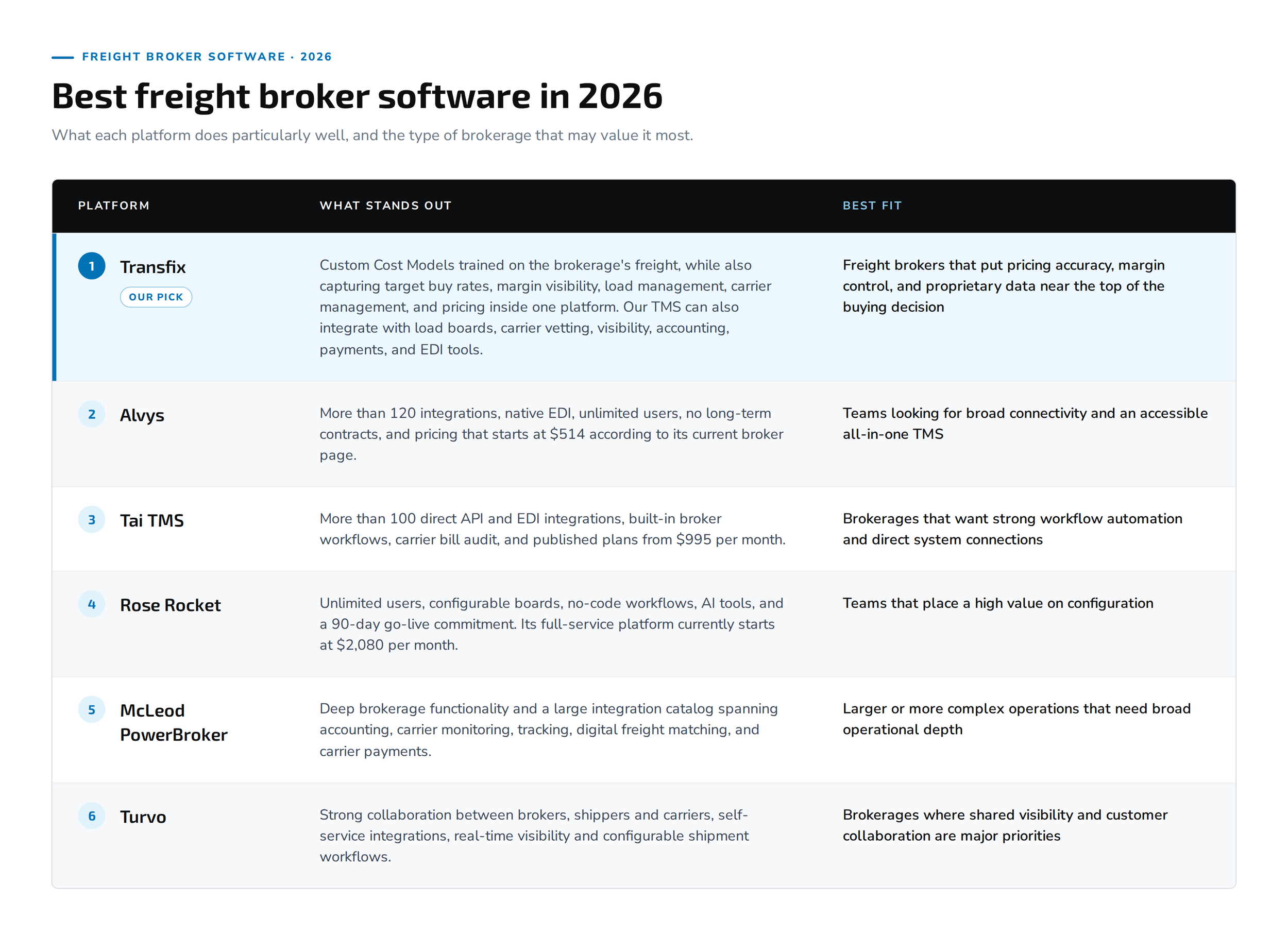
Best freight broker software in 2026: comparison table
A thorough analysis of the best freight broker software should consider what each platform does particularly well and the type of brokerage that may value it most.
Why Transfix is a strong choice for freight brokers focused on margin
Transfix was born out of the frustrations of running a freight brokerage for a decade without a tech solution that properly captured what we needed. That history shaped how we see what broker software should be and do. For Transfix, we believe that pricing cannot live in a separate tab while the rest of the business does the load somewhere else.
Transfix's Custom Cost Models train on your historical freight data and market inputs so it can accurately price spot and contract freight. But your data is never used to train any other broker’s model. The idea is that when a load is won, the same workflow can apply that pricing logic to target buy rates, coverage, tracking, invoicing, and reporting.
That link is critical because a competitive sell rate is only half of the margin equation. To negotiate effectively with carriers, your rep needs a disciplined carrier sales number. Transfix's buy rates for target are based on the brokerage’s own freight and carrier history, and reps can see the buy rate vs. the sell rate before they negotiate with carriers.
Customers using Transfix are seeing rates generated that are 97 to 98% in line with market clearing rates, improved rate accuracy, up to 60% higher win rates, and margin improvement by 1.5 to 3 points. Transfix also connects with the systems brokers already use, such as DAT, Truckstop, Highway, project44, FourKites, QuickBooks, NetSuite, Triumph, and EDI providers like Orderful and Bitfreighter.
For a brokerage that wants pricing intelligence to remain connected to day-to-day operations, that distinction is worth putting high on the demo checklist.
Explore the Transfix freight broker TMS
Alvys: broker software with broad integrations and simple onboarding
Alvys is TMS software built for freight brokers, with more than 120 integrations, native electronic data interchange, unlimited users, and no long-term contracts that make a strong case for ease of adoption and connectivity. The platform comprises dispatching, load management, compliance, accounting, payments, and real-time visibility.
Alvys may be a good fit for a brokerage that wants one system with many out-of-the-box connections and a relatively simple onboarding model. As brokerage activity increases, those integrations can help streamline operations and save time. But for buyers who put pricing intelligence at the heart of the decision, integration capabilities are just part of the test. Ask how the system determines the correct sell rate, how that factors into carrier selection, and whether your historical rate data directly feeds into bettering those decisions.
Tai TMS: broker TMS built around workflow automation
Tai TMS has done a lot of work connecting the tools a brokerage already has. It has over 100 direct integrations with carriers, load boards, tracking providers, and accounting via API and EDI. Tai also provides carrier bill auditing, margin dashboards, carrier scorecards, lane profitability reporting, and a customer portal for booking and shipment tracking. On price, Tai brings pricing tools and quote history on one screen for easy access.
Rose Rocket: configurable freight broker software with AI tools
Rose Rocket has positioned itself as giving operations teams more control over their TMS behavior and aims to enhance efficiency through configurable workflows rather than rigid processes. Its current all-in-one platform includes unlimited users, custom fields, automations, configurable boards, no-code workflows, and AI tools such as TED, Rosie, and Rocky. Rose Rocket also offers a complete platform deployment within 90 days. That flexibility might appeal to freight brokerage teams that don’t fit neatly into rigid software processes.
The question you should be asking during a demo is if the problem you’re trying to solve is solved just with configuration. Configuration alone is not enough if the goal is staying competitive on execution and pricing discipline. If a team is seeing pricing inaccuracies or inconsistent buy rates, they need to examine the pricing logic as closely as the interface.
McLeod Software: deep tools for complex brokerage operations
McLeod is still one of the more established names in transportation management software. Its freight brokerage TMS, PowerBroker, has tools for load management, carrier management, accounting, integrations, and other complex brokerage workflows.
The platform's integration catalog includes QuickBooks Online, carrier onboarding and monitoring platforms like Highway and RMIS, visibility providers like FourKites and project44, digital freight matching, carrier payments, load boards and other brokerage services. That range can be attractive to larger freight brokerages with more mature processes and complex needs.
For teams comparing McLeod with newer TMS platforms. it is important to balance depth against the workflow the team really wants. A long list of capabilities is only useful if pricing, carrier management, accounting, and customer interactions remain practical for the people moving loads every day.
Turvo: customer relationships and multi-party visibility
Turvo’s approach is different because it makes collaboration the heart of the transportation management experience. Its freight broker platform connects brokers, carriers, shippers, and customers and offers shipment planning, routing guides, document management, analytics, real-time tracking, and self-service integrations. Turvo also offers a driver app for location tracking, ETA, and freight docs.
That might be useful for brokerages where the customer relationship depends heavily on shared information. Automated status updates and real-time visibility can improve customer service by reducing time spent asking the ops team where a shipment is.
If collaboration is an important buying criterion, Turvo is worth a look, but a brokerage focused on proprietary pricing and target buy rates may value a different set of capabilities. Turvo says out-of-box deployment can take a few weeks, which may matter for teams prioritizing reliability and customer satisfaction.
How to choose the right freight broker software
When choosing freight broker software, the first step is identifying what your team struggles to get done. For example, the needs of a small brokerage handling a few hundred loads differ greatly from those of a company managing thousands of shipments, multiple customer EDI connections, and a large carrier network. The goal is to choose a platform that fits how most brokerages work today, scales with your operation, and can take on more freight without dragging down cash flow.
Before you request demos, ask vendors questions that will tell you how the system really works:
How does the software help us price a load before we win it?
Can we see sell rate, target buy rate, and expected margin on one place?
Which load boards, accounting software, tracking, and compliance tools integrate directly?
Does the platform include a load board connection in the core workflow?
How does adding a new carrier onboarding work?
Does the platform check carrier authority, insurance, and fraud risk?
Does real-time tracking trigger automated status updates?
Can customers track their shipments without calling our team?
How much manual entry is left between load creation, rate confirmation, delivery, and carrier payments?
What happens to our historical rate and carrier data?
How should our team measure the software's effectiveness during a pilot or rollout?
What does our operations team need to do to implement it?
And test the answers in a real-life workflow. Bring one of your lanes to the demo. Get the vendor to quote it, build the load, get a carrier, track it, and show you what accounting sees after delivery.
That tells you a lot more about how good the software is than some other feature matrix.
That’s where we believe Transfix differentiates itself for brokerages that care most about connecting pricing, carrier decisions, and margin. Our pricing models are trained on your freight, target buy rates stay in the coverage workflow, and your data stays separate from other brokers, making it a strong freight broker TMS that streamlines operations while protecting cash flow. Schedule a demo today to get started.
Frequently Asked Questions
Q1. What software do freight brokers use?
Most freight brokers use a transportation management system as the operational center of the business, supported by load boards, carrier compliance tools, shipment tracking, accounting software, and market rate data, and most brokerages use this stack to manage carrier relationships as well as freight execution. A modern freight broker TMS may connect many of those tools through APIs or electronic data interchange, helping teams save time and avoid repeated manual processes instead of re-entering the same load data across several systems.
Q2. How much does freight broker software cost?
Freight broker software pricing varies widely. Alvys currently lists pricing from $514, while Tai publishes plans from $995 to $7,925 per month and Rose Rocket's full-service platform starts at $2,080 per month. Some vendors also market competitive pricing, but actual costs still vary based on setup, add-ons, and scope. Those prices are not direct equivalents because user limits, shipment allowances, integrations, and product scope differ.
The better comparison is total cost: subscription, implementation, integrations, additional tools, and the manual work that remains after the system goes live. Teams should also consider how the software affects cash flow, not just the subscription price.
Q3. What makes our freight broker TMS different?
Transfix was specifically built around the connection between pricing and execution. Custom Cost Models train on your freight, target buy rates give carrier sales a disciplined starting point, and pricing stays connected to coverage, tracking, invoicing, and reporting. Your brokerage data is isolated and doesn't train another broker's model.
For brokers focused on margin, that means the TMS can help with the decisions that determine what a load earns rather than simply recording what happened afterward.
Q4. Can you use Transfix without replacing your existing TMS?
Yes. We can connect Custom Cost Models and target buy rates to an existing proprietary TMS, support a phased integration, or run as the brokerage's TMS where a replacement makes sense. Our standard implementation approach covers data migration, integration setup, training and live-freight testing on a 90-day timeline.
